For manufactured ADU utility connections in San Diego, start with the parcel rather than the floor plan. Confirm the governing jurisdiction, available services, connection location, site access, and each contractor’s scope before comparing proposals. Written answers now can expose gaps that a home price alone won’t show.
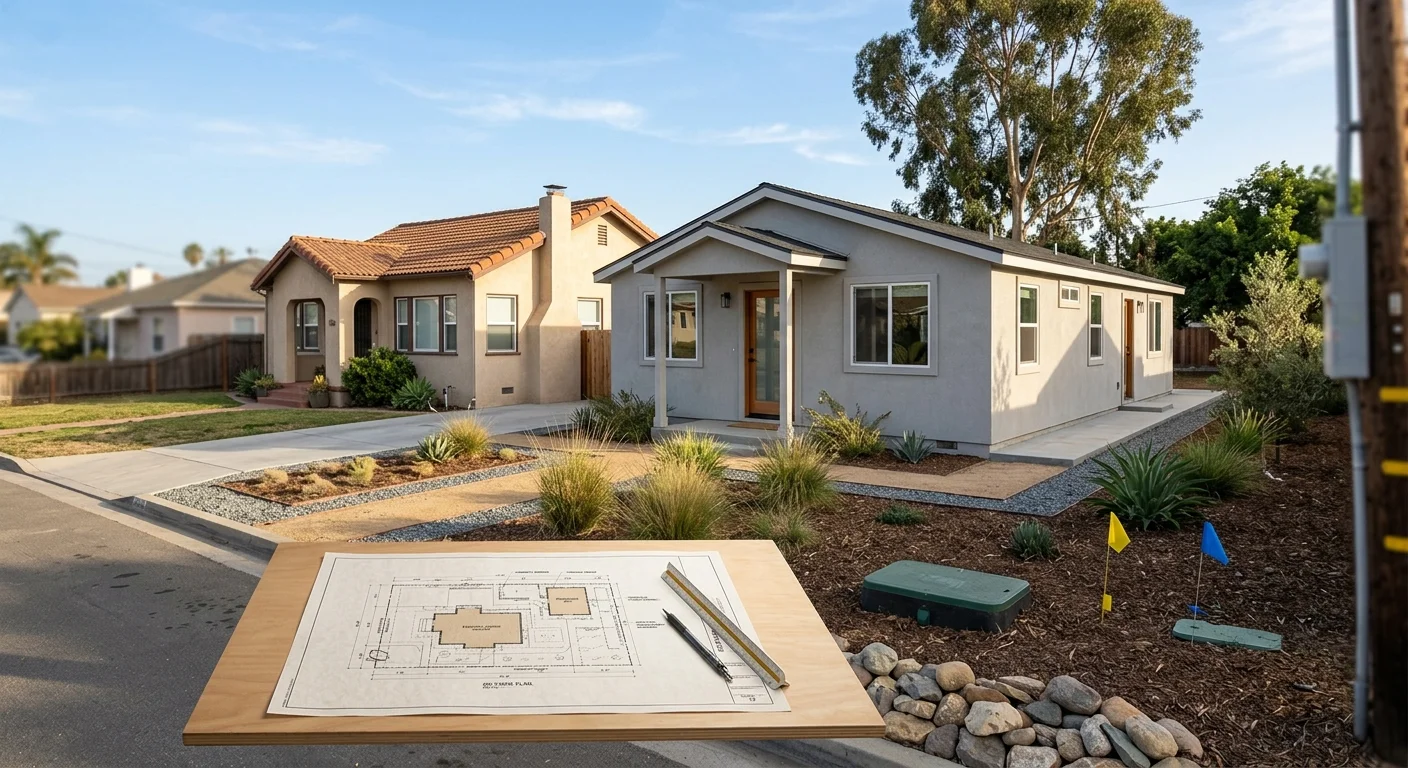
Identify the San Diego city or county jurisdiction
Begin by confirming which local government reviews the specific property. A San Diego mailing address doesn’t answer that question by itself. Ask the property owner, planning counter, or qualified site professional to identify the governing jurisdiction in writing.
Record the property address and parcel identifier exactly as they appear on current documents. Give that same information to every agency and professional you contact. Small differences in an address, unit label, or parcel reference can send a question down the wrong path.
For an unincorporated parcel, San Diego County Planning & Development Services is the county destination for current planning and permit information. Properties within a city should be checked with that city’s planning or development office. Don’t assume a nearby city hall controls the parcel.
You can also review the California HCD accessory dwelling unit page for current state-level information. The page doesn’t replace a parcel-specific answer from the governing agency.
Ask the jurisdiction to clarify who reviews the proposed manufactured ADU and its site work. If the answer separates responsibilities among agencies, record each contact and topic. Don’t guess which office controls a utility connection, foundation, or related improvement.
This jurisdiction check belongs before design selection. The manufactured home ADU guide can help you frame the larger project, but the local authority must confirm what applies to your lot. If a rule, fee, form, or review path isn’t confirmed, label it “not confirmed” in your notes.
Confirm which utility services reach the lot
A utility visible near the property isn’t enough for planning. You need written, parcel-specific answers about each service the ADU may use. Start with electricity, water, wastewater, gas if proposed, and communications if they matter to the project.
For every service, ask the same core questions:
- Who provides or controls the service at this parcel?
- What existing equipment or connection serves the property?
- Can the proposed ADU connect to that service?
- What location should the project team use for planning?
- What field review, documents, or professional evaluation are needed?
- Which details remain unconfirmed?
These are questions, not assumed requirements. The utility, governing agency, installer, and qualified site professionals must supply the answers for the property.
Request maps, account records, plans, photographs, or written notes that support each response. Mark the source and date on every item. A verbal answer can guide the next call, but it shouldn’t quietly become a fixed project assumption.
Don’t infer capacity from a meter, pipe, access cover, pole, or line seen from the street. Don’t assume an existing house connection can also serve an ADU. Ask the controlling provider or qualified professional to evaluate that question.
Conditions can also differ across San Diego County. An alley-served central San Diego lot raises different access questions than a hillside East County parcel. A South Bay infill property may require a different verification path than an inland lot. Those examples don’t establish rules. They show why the actual parcel must drive the checklist.
Our broader guide to utility checks before placing a home on land offers a useful starting worksheet. Keep every unknown open until the responsible authority or professional confirms it.
Separate factory scope from site connections
California’s statutory definition says a manufactured home includes plumbing, heating, air-conditioning, and electrical systems within the home. That doesn’t tell you what a particular seller’s proposal includes outside the unit. Review current regulator information through California HCD’s manufactured and mobilehomes page.
Ask each dealer to divide the proposal into clear scopes. Useful headings include the factory package, delivery and placement, site preparation, utility-related work, permits or agency coordination, and owner-provided items. The headings don’t decide who performs the work. They force each party to state its role.
For every utility, trace the proposed path from the service source to the connection point at the ADU. Then ask who designs, supplies, installs, coordinates, inspects, and pays for each portion. If a line item says only “utilities,” request a written explanation.
Also ask what information the factory needs before production. Service locations, entry points, equipment choices, and plan assumptions may appear across different documents. Have the dealer and qualified site professionals identify any conflicts before you commit to a design.
Compare exclusions as carefully as inclusions. An excluded item isn’t automatically a problem. An unidentified responsibility is. The goal is to avoid two parties assuming the other will handle the same task.
Land & Home SD doesn’t sell ADUs, connect utilities, perform installation, or set project prices. We guide buyers and connect them with licensed, independent local manufactured home professionals. The buyer contracts with and pays the selected professional directly.
When comparing proposals, keep the utility worksheet beside the home specifications. That makes it easier to see whether two quotes cover the same work. Our private-land placement guide explains the wider set of questions surrounding a home placed on an individual parcel.
Check access before choosing the ADU plan
A floor plan can fit on paper while its delivery and utility paths remain unresolved. Walk the property with the people responsible for evaluating access. Give them the proposed home dimensions and the parcel information, then ask what must be confirmed.
Document the route from the public approach to the proposed placement area. Note gates, driveways, alleys, turns, overhead conditions, slopes, walls, landscaping, existing structures, and occupied areas. Don’t decide whether any condition is acceptable yourself. Photograph it and ask the dealer, installer, and relevant site professionals to evaluate it.
Utility planning needs the same physical review. Mark the proposed ADU location, known service features, and possible work areas on a simple parcel copy. Keep every mark labeled as existing, proposed, or unconfirmed. An unreadable sketch or an unlabeled line can create false certainty.
Ask whether the proposed home orientation leaves workable areas for the connections being evaluated. Also ask whether planned utility work conflicts with delivery access, equipment access, drainage features, trees, fences, or areas the owner wants protected. The responsible professionals should resolve those conditions.
Don’t treat access as a final delivery question. It can affect which home configuration deserves further study. A smaller or differently oriented plan may create a better project path, but only the project team can evaluate that tradeoff for the parcel.
Use the manufactured ADU lot-fit checklist alongside the utility notes. Lot fit and utility verification should inform each other before a buyer narrows the plan.
Get parcel-specific answers before comparing quotes
Build one verification packet for the property. It should contain the parcel identification, jurisdiction response, utility contacts, available records, site photographs, marked plans, dealer documents, and a running list of open questions.
A simple status system keeps the packet honest:
- Confirmed: supported by a dated written response or project document.
- Needs professional review: assigned to the dealer, installer, utility, agency, or qualified site professional.
- Not confirmed: no reliable parcel-specific answer has been obtained.
- Changed: an earlier assumption was replaced by newer information.
Never convert “not confirmed” into a guessed rule, price, capacity, or schedule. Ask the authority that controls the issue. If that authority refers you elsewhere, record the referral and continue the check.
Before comparing proposals, give every dealer the same packet. Ask each one to list the assumptions used in preparing its scope. This creates a fairer comparison because differences become visible. One proposal may address an item that another leaves open.
Pay close attention to allowances, exclusions, owner responsibilities, and undefined utility language. Don’t add a private estimate to fill a blank. Ask who can verify the item and what information that person needs.
A good decision checkpoint comes before signing for the home. By then, the buyer should know which answers are confirmed, which require more work, and which party owns each next question. The packet should also identify any design choice that depends on an unresolved utility or access issue.
This process doesn’t promise that every unknown disappears at once. It gives the buyer a clean record of what’s known and who must answer the rest. That’s the practical purpose of a San Diego ADU utility checklist.
When to call us
Call before choosing a manufactured ADU plan or comparing proposals with different utility assumptions. Land & Home SD can help you organize the questions and identify the licensed local professional needed for the next conversation. Call us at (858) 400-4608 and we’ll walk through your options and connect you with a licensed local dealer.