A manufactured ADU may fit your San Diego lot, but lot width alone won’t settle it. You need parcel-specific confirmation of jurisdiction, access, utilities, and installation scope before choosing a floor plan. Treat the answer as unconfirmed until the governing office and licensed professionals review the proposal.
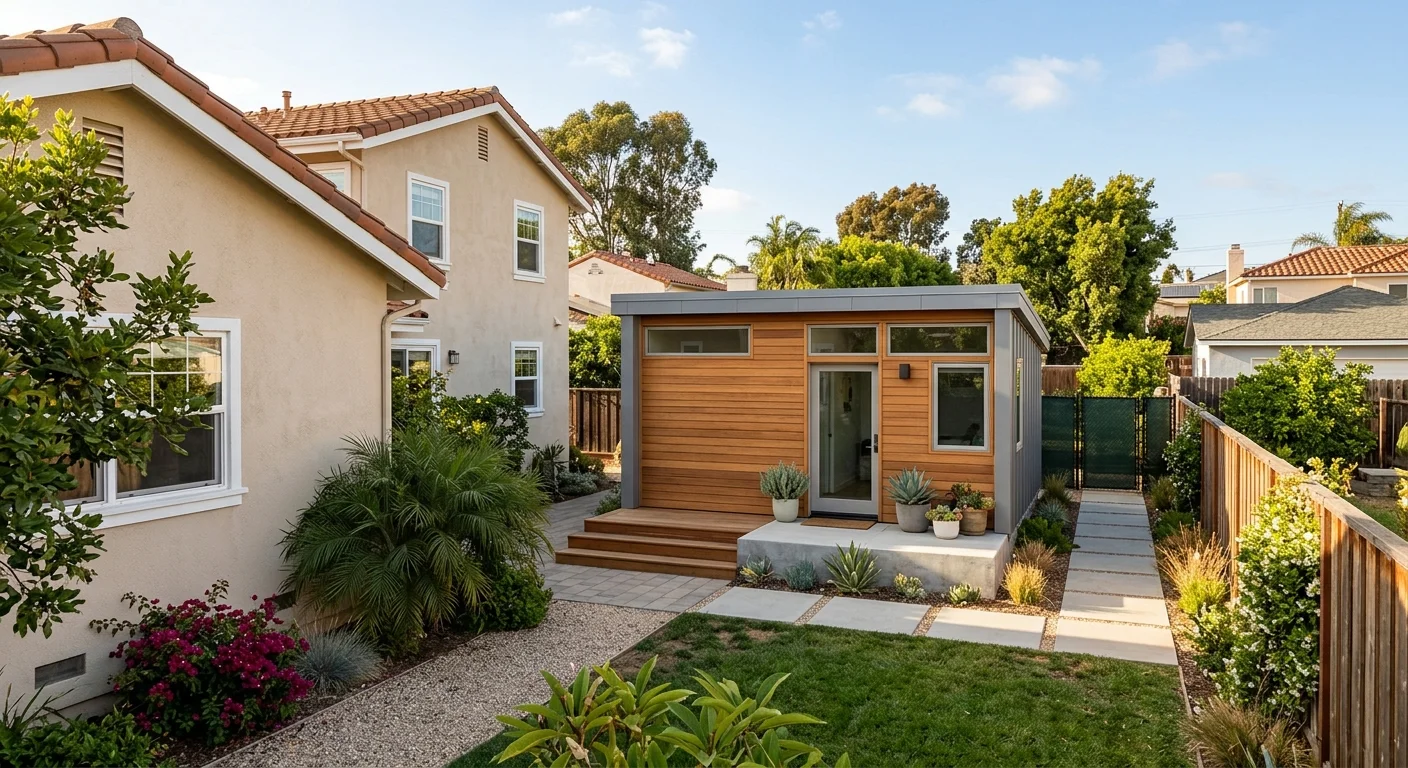
Start with the lot, not a floor plan
A polished floor plan can make an ADU feel settled too early. Start with a parcel record and a rough site sketch. Mark the existing home, driveways, gates, walls, meters, utility panels, trees, and grade changes. Label anything you haven’t confirmed.
Don’t decide from a listing photo or satellite image. Walk the site with the delivery and installation questions in mind. Record the narrowest apparent access points, but don’t treat your measurements as professional clearance. A licensed installer must confirm whether the proposed home can reach and occupy the planned location.
Confirm the product category as well. California law distinguishes manufactured homes from factory-built housing. A manufactured home is built on or after June 15, 1976, rests on a permanent chassis, and meets the other elements in the state definition. Factory-built housing is a different category and excludes manufactured homes. A seller’s use of “prefab” doesn’t answer which legal category applies.
That distinction matters because the responsible agencies and documents may differ. Ask the seller or dealer to identify the unit in writing. Request the manufacturer’s information for the exact model under consideration. Don’t rely on a loose label from an advertisement.
Our manufactured home ADU service explains how Land & Home SD guides buyers and makes local referrals. The separate San Diego manufactured ADU guide covers the broader topic. This page stays focused on one earlier decision: whether the proposed home and lot appear compatible enough to pursue.
Verify which jurisdiction controls the parcel
The first permit question is who controls the parcel. Don’t infer that answer from a mailing address. Ask the appropriate planning or building counter to confirm whether the property falls under a city or San Diego County review.
For a parcel handled by the county, start with San Diego County Planning & Development Services. For a city-controlled parcel, contact that city’s current planning or building office. Save the name of the office, the date, and the written response.
Manufactured ADU requirements must be checked for the parcel and governing jurisdiction. Ask that office for the current setback, height, size, parking, utility, and other standards that apply to the proposed use; don’t copy figures from another address.
Describe the proposal carefully when you ask. Say that you’re considering a manufactured home for use as an ADU. Provide the parcel number and the exact product category given by the dealer. Ask which office reviews the structure, which office reviews the site, and whether another agency must participate.
The California HCD accessory dwelling unit page is a useful state starting point. It doesn’t replace a parcel decision from the governing jurisdiction. Ask for the current application, submittal checklist, and written standards that apply to your proposal.
Keep the response with your project notes. A verbal summary can be misunderstood when a model, foundation plan, or site layout changes. Written confirmation also gives the dealer and installer the same starting information.
Check access, utilities, and parcel constraints
A floor plan shows the finished home. It doesn’t prove that the sections can reach the planned location. Walk the possible route from the street to the proposed pad with a licensed installer.
Note gates, fences, tight turns, roof overhangs, overhead lines, retaining walls, trees, and changes in grade. Photograph each narrow or uncertain point. Ask the installer what measurements and clearances must be confirmed for the exact home. Don’t assume an obstacle can be moved, crossed, or worked around.
This review must stay local to the parcel. An Encinitas example doesn’t confirm an El Cajon lot. A Chula Vista project doesn’t settle a City Heights proposal. The governing office and the licensed professionals must review the actual address and proposed layout.
Utilities need the same treatment. List the providers shown on current bills and parcel records. Mark visible meters, panels, cleanouts, and service entrances without claiming what they serve. Ask each provider or governing office where connections may be considered and what review applies.
Don’t guess whether existing service has enough capacity. Don’t assume a nearby line can serve the ADU. Ask who determines capacity, who approves the proposed route, and which licensed professional prepares the needed plans. Get any stated charges directly from the organization that sets them.
Parcel records may also reveal easements or other limits that need review. Ask the governing office which recorded documents and site conditions matter. If drainage, septic service, fire access, grading, or another issue appears relevant, request the current standard from the responsible authority.
The goal isn’t to solve each technical issue yourself. It’s to identify open items before a dealer builds a quote around an unconfirmed site.
Separate the factory scope from site work
A manufactured ADU purchase and its site work shouldn’t be treated as one vague package. Ask every dealer to separate included work, excluded work, and work assigned to another professional. Compare written scopes, not just the final price.
The factory portion may describe the home and its selected features. The site portion can involve different companies and approvals. Ask who is responsible for delivery, installation, foundation plans, permits, utility work, grading, access preparation, and restoration. Don’t assume any item is included unless the quote says so.
Permanent foundation work has verified state requirements. Under California Health and Safety Code Section 18551, an owner must obtain a building permit before installing a manufactured home as a permanent fixture. The process includes approved foundation plans and specifications, manufacturer installation instructions, and evidence concerning the property interest. The responsible enforcement agency must confirm how those requirements apply to the proposed project.
Land & Home SD doesn’t sell the home, prepare regulated plans, pull permits, or perform installation. We guide buyers and connect them with licensed independent manufactured home professionals. The customer contracts with and pays the selected professional directly.
Our guide to putting a manufactured home on private land explains that referral path. The related private-land planning article helps buyers organize questions beyond the ADU decision.
Ask who controls each document after installation. California HCD handles manufactured home registration and titling rather than the DMV. Don’t assume that foundation, title, tax, or recording terms are interchangeable. Have HCD, the enforcement agency, and the involved professionals explain the current process for your project.
Confirm open questions before dealer quotes
A useful quote begins with the same verified project details for every dealer. Give each one the parcel information, jurisdiction response, proposed site sketch, known access notes, and requested home category. If something remains unconfirmed, label it clearly.
Ask the dealer to answer these points in writing:
- What is the exact legal category of the proposed unit?
- Which manufacturer documents identify the model and its dimensions?
- Which parts of delivery and installation are included?
- Who prepares the foundation and site plans?
- Who submits each permit or approval request?
- Which utility tasks are included, excluded, or still unknown?
- Which site conditions could change the scope?
- Which figures come from the dealer, installer, jurisdiction, or utility provider?
- What assumptions could change after a site review?
- What payment terms apply, and who receives each payment?
Confirm each current figure with the party that sets it before signing or paying. A missing figure should remain “not confirmed” until that source answers.
Dealer and salesperson licensing is enforced by California HCD. Ask HCD how to confirm a professional’s current status through its occupational licensing resources. Land & Home SD doesn’t hold a trade license and doesn’t provide a project warranty.
Compare quote versions carefully. A lower total may reflect fewer included tasks or unresolved site work. Ask each dealer to date the scope and identify its exclusions. If one proposal calls an item included while another doesn’t mention it, request clarification before comparing totals.
A quote can’t prove lot feasibility by itself. The stronger sequence is parcel confirmation, access review, utility questions, written scopes, and then quote comparison.
When to call us
Call before committing to a model, land plan, or dealer quote with unresolved site assumptions. Land & Home SD offers buyer guidance and a free, no-obligation referral. Call us at (858) 400-4608 and we’ll walk through your options and connect you with a licensed local dealer.