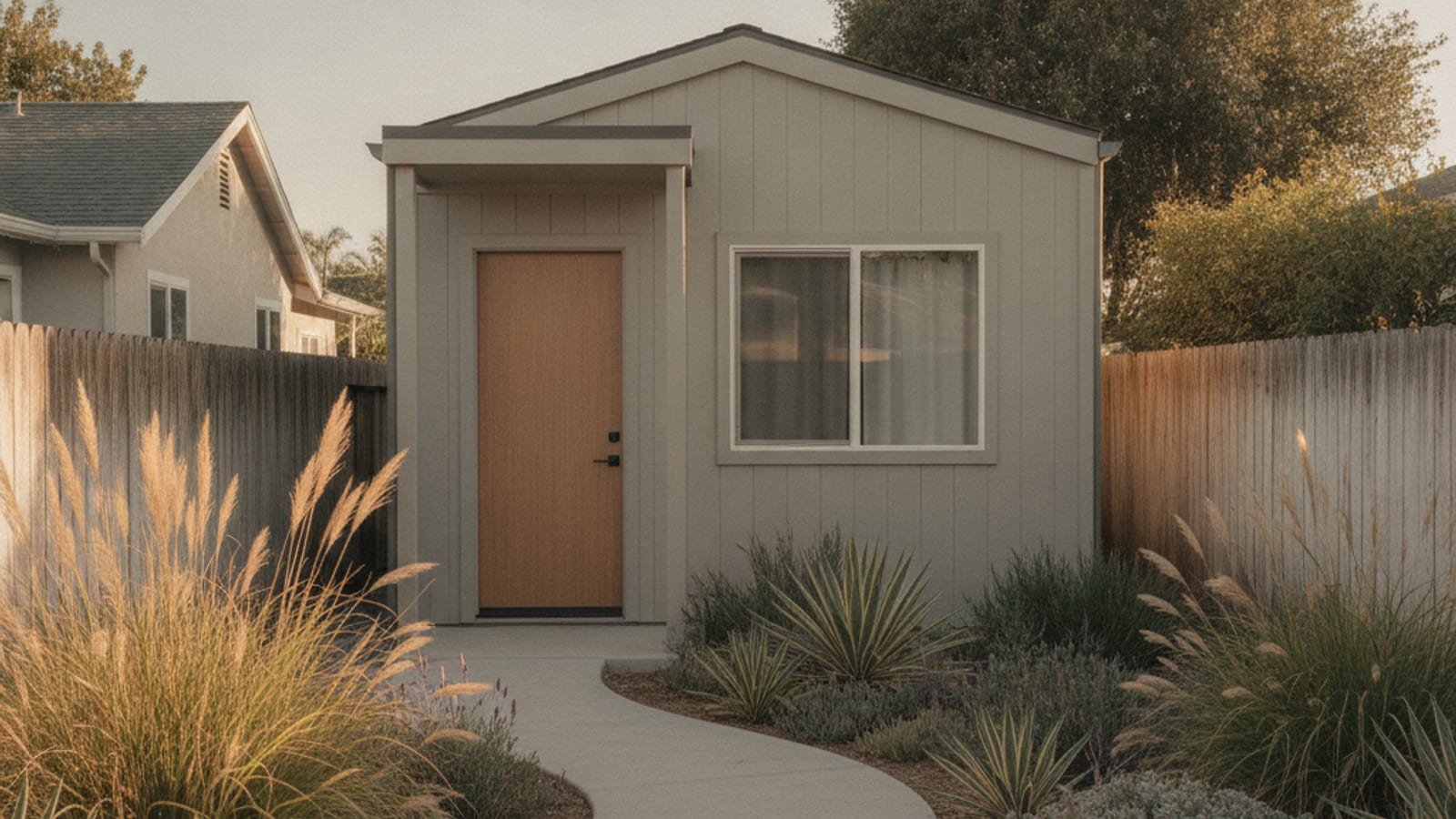
The rules have also changed significantly in the last two years. Here’s what applies in 2026 and what you need to know before you start.
What makes a manufactured home a valid ADU
California state ADU law does not restrict ADUs to site-built construction. A manufactured home that meets all applicable building standards, is properly permitted, and is installed on a permanent foundation qualifies as an ADU.
The home must be:
- Built after June 15, 1976 with a valid HUD certification label
- Installed on a permanent foundation (required for real property conversion)
- Compliant with San Diego County’s design standards for manufactured homes, including conventional siding, roof pitch of at least 2:12, and eave overhangs of at least 1 foot
If those conditions are met, the manufactured home functions as an ADU for all permit and regulatory purposes.
Size limits and setback rules in 2026
State law in 2026 allows detached ADUs up to 1,200 sq ft. ADUs 850 sq ft or smaller (or 1,000 sq ft if they have more than one bedroom) cannot be denied based on floor-area-ratio or lot coverage standards. In practice, this means most residential lots in San Diego County can accommodate a manufactured home ADU without fighting zoning math.
Setbacks for detached ADUs in most cases are:
- 4-foot rear and side setbacks under state law
- High and very-high fire hazard severity zones require 4-foot setbacks with ignition-resistant construction materials. A large portion of unincorporated San Diego County falls in these zones.
Front setback requirements still apply. The ADU cannot reduce required parking below what the main home needs unless a parking exception applies.
Owner-occupancy is not required for most ADUs in 2026. California state law eliminated the owner-occupancy requirement for ADUs in 2020, and that rule remains in effect.
AB 1033: Selling your ADU separately
This is the rule change with the biggest financial implications.
AB 1033 lets a local jurisdiction allow ADUs to be sold separately as condominiums. Whether that option exists at a given San Diego County address depends on the city or County ordinance in force there. Ask the reviewing agency, in writing, whether a proposed manufactured ADU can be sold separately before you structure a project around that exit.
This is newer territory. Get current guidance from the agency and a real estate attorney familiar with that jurisdiction’s implementation before you count on a separate sale.
Impact fees: the big cost savings for small ADUs
Impact fees are fees charged by local agencies to offset the infrastructure burden of new development. For ADUs they can add up to significant money.
Under California Government Code section 66311.5, no local agency, special district, or water corporation may impose an impact fee on an ADU with 750 sq ft or less of interior livable space. Above that threshold, fees are charged proportionally to the square footage of the primary dwelling. Note that the statute exempts impact fees specifically, not utility connection fees or capacity charges, which are treated separately.
An 800 sq ft manufactured home ADU is above the threshold and will incur proportional fees. An ADU at exactly 750 sq ft of interior livable space, or below it, gets the full exemption. If you’re targeting the lowest total cost and your household needs can be met in a smaller footprint, staying at or under 750 sq ft has a real financial payoff.
What does a manufactured home ADU cost all-in?
There is no honest countywide all-in number. Collect current written quotes for the home, delivery, foundation, utilities, site work, permits, and fees on the exact parcel. Compare those line items instead of a published range.
Under California Government Code section 66311.5, an ADU with 750 square feet or less of interior livable space is exempt from impact fees. That statute does not waive utility connection fees or capacity charges. Ask the reviewing agency which charges apply to the proposed size.
Comparing manufactured home ADUs to site-built ADUs
A manufactured home ADU is built to HUD standards in a factory. A site-built ADU is designed and constructed to the local building code on site. Factory production can reduce on-site construction time, but it also limits custom matching to the main house. Compare both paths with the same parcel rules, written quotes, and a confirmed permit path. Do not assume one is cheaper until those figures exist.
The permit process
The ADU permit process for a manufactured home mirrors the standard private-land installation process:
- Pre-application with San Diego County PDS to confirm the parcel qualifies and get guidance on what’s required.
- Permit applications for grading, foundation, and the ADU itself.
- Installation and inspection of foundation and utilities.
- HCD Form 433A recorded after installation to convert the home to real property.
- Final inspection and certificate of occupancy from the county.
Timeline from application to occupancy depends on design readiness, agency backlog, site conditions, and inspection corrections. Ask each responsible party for a current sequence. Do not use a countywide month range as a schedule.
Can the ADU be rented out?
Yes. Owner-occupancy is not required for ADUs in California in 2026. You can rent the manufactured home ADU as a long-term rental. Short-term rental (vacation rental) rules vary by city and county ordinance, so check current short-term rental regulations for your jurisdiction before pursuing that path.
Start with a parcel check
Not every parcel in San Diego County is straightforward for a manufactured home ADU. Zoning, fire hazard designation, lot size, and existing improvements all affect what’s possible and how much it costs.
Land & Home SD helps buyers evaluate their property before committing to anything. Call (858) 400-4608 or visit our manufactured home ADU service page for a free initial conversation about your parcel.