A useful mobile home replacement quote in San Diego separates the home from removal, installation, site work, utilities, and approval conditions. Compare written scopes, not just the final totals. Any unanswered item should stay open until the responsible party confirms it.
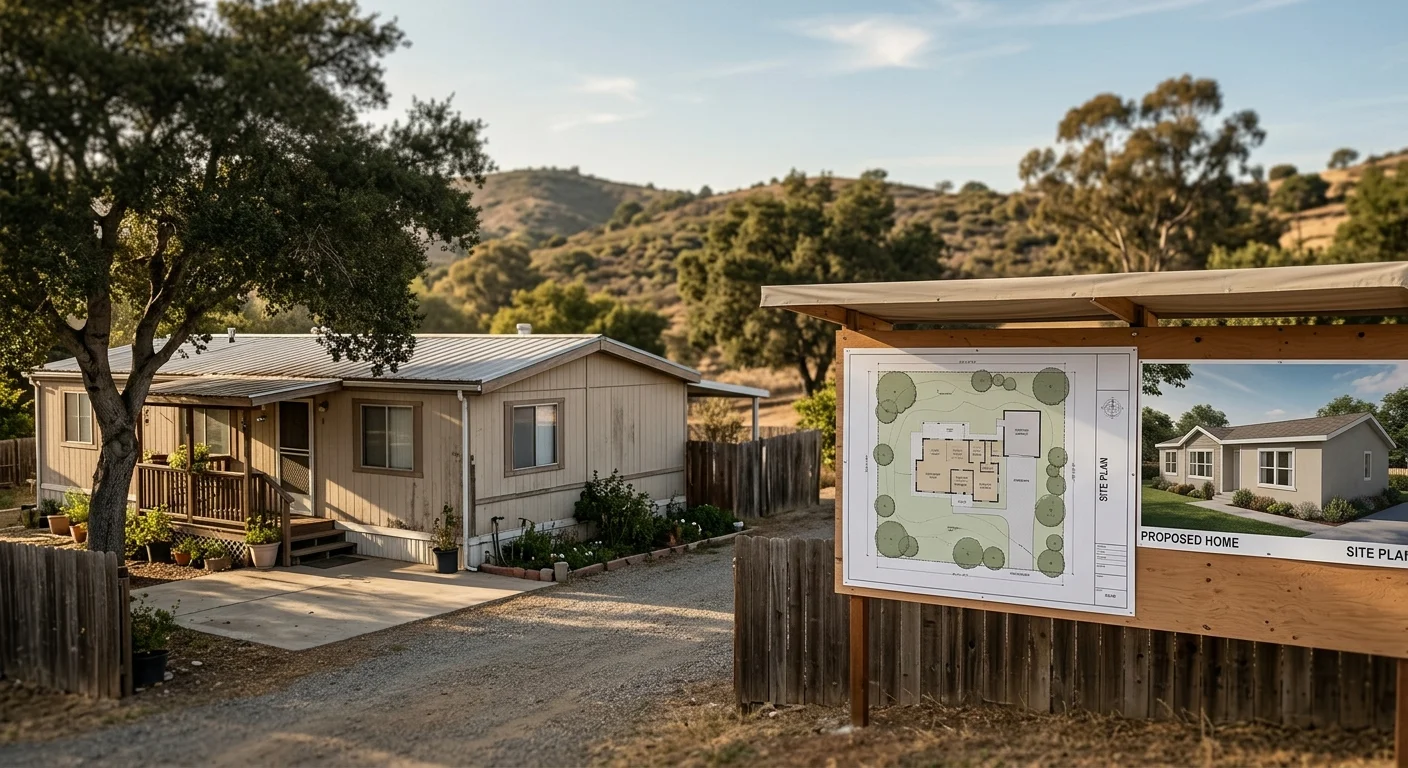
Separate removal from the replacement-home quote
Replacing an existing home involves two different scopes. One covers what leaves the site. The other covers what arrives and gets placed there.
Start by asking whether removal appears anywhere in the replacement proposal. If it does, identify the party responsible for that work. Then ask for a separate description of everything included. A single line marked “removal” doesn’t explain enough for a fair comparison.
The removal scope should identify the existing home and affected site items. Ask how the proposal treats porches, steps, skirting, awnings, sheds, decks, landscaping, and loose materials. Don’t assume an attached feature is included merely because it touches the home.
The document should also identify responsibility for utility disconnections, hauling, disposal, and site cleanup. If another company handles those items, request its proposal separately. You can then compare the removal scope without confusing it with the replacement home.
This separation also protects the decision you’re making now. Owners still weighing repairing, selling, or replacing an older mobile home shouldn’t treat a bundled total as proof that replacement is the right choice.
Create two columns before comparing proposals: “existing home out” and “replacement home in.” Place every line item into one column. Anything that fits neither column needs an explanation. Land & Home SD doesn’t remove, transport, sell, or install homes. We help owners organize the decision and connect with licensed independent local professionals.
Match dealer and installer scopes
Two proposals can show different totals because they describe different jobs. Before comparing them, make the dealer and installer scopes match line by line.
Ask the dealer to identify the exact home being quoted. The proposal should distinguish the base home from selected options and later choices. It should also state whether transportation, delivery coordination, placement, assembly, or finish work appears in that dealer’s scope.
Next, ask who handles the installation work. Don’t rely on a company name alone. Record the responsible business beside each task. That includes site preparation, support or foundation work, exterior completion, utility connections, access features, and final corrections.
Use three labels throughout your comparison:
- Included in this proposal
- Excluded from this proposal
- Assigned to another party
“Available” isn’t the same as included. “To be coordinated” also needs a named coordinator. If the dealer expects an installer to price something later, mark that amount and scope as open.
A strong replacement manufactured home quote lets you trace each task to a written document. It shouldn’t require you to guess where one company’s responsibility ends.
California HCD regulates this vertical. Start with its manufactured and mobilehomes page when checking the agency’s current information. For a dealer or salesperson, use the HCD occupational licensing page as a starting point and ask HCD to confirm any status you can’t verify there.
Our mobile home replacement guide can help you frame the full project before matching proposal lines.
Check park or land approval conditions
A San Diego County replacement proposal must connect to the actual site. A park space in Chula Vista isn’t interchangeable with private land in East County. The address, ownership setting, and deciding authorities belong in the comparison.
For a home in a park, ask for the current written park conditions that affect the proposed replacement. Identify who must review the home, site plan, exterior choices, delivery approach, and work areas. Don’t treat a dealer’s expectation as park approval. Record the person or office that can confirm each condition.
Ask how the proposal handles existing features around the space. These may include stairs, decks, sheds, carports, fencing, landscaping, and utility locations. The purpose isn’t to assume any feature must change. It’s to show whether each feature was reviewed, excluded, or left unresolved.
For private land, ask which government authority covers the address. If the proposal points to San Diego County, confirm current information through Planning & Development Services. If another jurisdiction controls the address, ask for that agency’s written direction instead.
Don’t publish or accept an unverified permit rule, approval sequence, or fee. The authority responsible for the address must provide the current answer.
The same discipline applies when a replacement stays at the existing address. Review our guide to replacing a mobile home on the same lot, then ask which site conditions have actually been checked. “Same lot” doesn’t answer the open questions inside a mobile home replacement proposal.
Compare exclusions, allowances, and warranties
The shortest lines in a proposal can carry the biggest uncertainties. Read every exclusion, allowance, option, note, and attachment before comparing totals.
For each allowance, ask what product or task it represents. Request the selection assumptions in writing. Then ask how the final proposal changes if the selected item differs from that assumption. Don’t convert a placeholder into a confirmed amount in your own worksheet.
Exclusions need the same treatment. Copy each one into a separate list. Then assign it to the dealer, installer, removal provider, owner, park, land professional, or another named party. If nobody accepts responsibility, the item remains open.
Watch for scope lines that depend on site conditions. Ask what has already been observed and what still needs review. The proposal should separate a confirmed inclusion from work that may receive separate pricing later. That distinction matters more than a polished package description.
Warranty language also needs names and documents. Ask who issues each warranty, which product or work it addresses, and where its current terms appear. Don’t assume a factory document covers dealer or installer work. Don’t assume a dealer document covers another company’s work.
Land & Home SD doesn’t issue warranties. The responsible company and the factory provide their own documents and terms. Review those documents before ordering, and direct coverage questions to the issuer.
For a broader look at the cost categories buyers may encounter, see our manufactured home cost and pricing guide. It doesn’t replace a site-specific quote, but it can help you spot categories missing from the proposal comparison.
Confirm every open item before ordering
Turn the proposal comparison into a decision sheet. Each row should name one task, the responsible party, its document, and its current status. Use “confirmed,” “excluded,” or “open.” Avoid softer labels that hide uncertainty.
Your final check should cover these groups:
- Existing-home removal and affected site features
- Replacement home, options, and dealer scope
- Transportation and delivery responsibilities
- Installation and exterior completion
- Site, foundation, and access work
- Utility disconnections and connections
- Park or land conditions
- Government contacts and pending answers
- Allowances, exclusions, and later selections
- Warranty issuers and supporting documents
Then compare the proposals again. If one contains a task that another omits, don’t treat the totals as equivalent. Ask the second provider to add the item, exclude it clearly, or name the party expected to handle it.
Save every revision with its date. Make sure the home description and selected options stay consistent between the proposal, attachments, and site documents. If a conversation changes the scope, request an updated written version.
Don’t sign based on an answer that lives only in a call or text thread. Put the answer beside the affected line item. Confirm who owns the next action and which document will close it.
A useful owner file doesn’t need fancy software. A folder and a simple table can expose gaps quickly. The goal is one readable chain from removal through placement, with no unassigned work between them.
Keep unresolved government, park, title, licensing, and warranty questions with the authority or issuer that controls them. If a specific rule, amount, or term can’t be confirmed, label it “not confirmed.” That’s more useful than filling the gap with an assumption.
When to call us
If removal responsibility, site approval, installation scope, or an allowance remains unclear, talk it through before committing. Land & Home SD can help organize your questions and connect you with an appropriate local professional. Call us at (858) 400-4608, leave a message about your project, and we can connect you with a licensed local dealer.