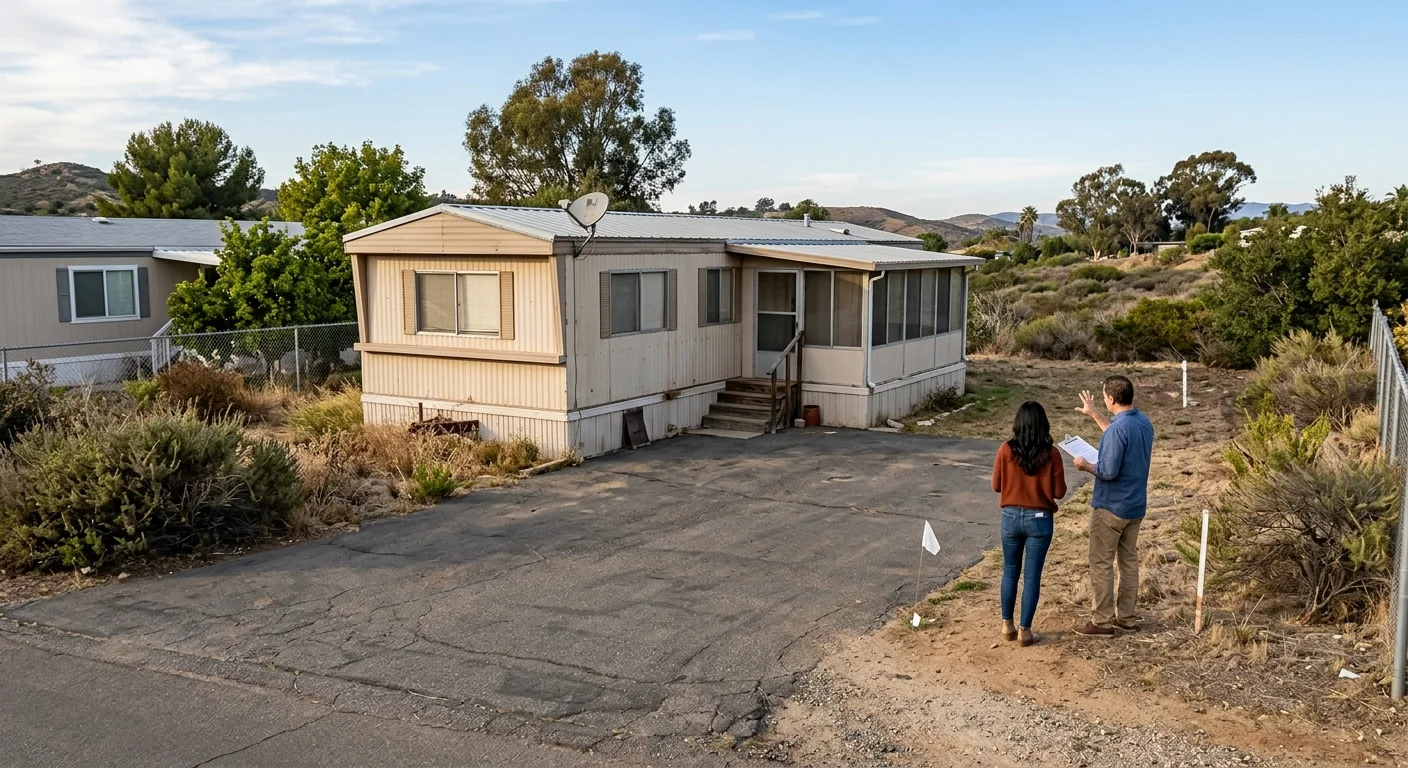
Mobile home removal in San Diego starts with a decision, not demolition. Before an older home leaves its lot, confirm what happens next, who controls the site, and who handles each unresolved step. Those answers protect the replacement plan from gaps between separate contractors.
Separate removal from relocation
Start with two separate questions. Does the existing home need to leave this lot? If it does, will someone relocate it or remove it through another approved plan?
Those paths shouldn’t share one vague line in a proposal. Relocation involves preserving the home for transport and another destination. Removal may involve a different contractor and endpoint. The condition of the home, its ownership records, site access, and the receiving party’s requirements can affect which path remains available.
If moving the home is still under consideration, review the cost and planning questions for moving a mobile home. That guide helps identify expenses that need contractor confirmation. It doesn’t establish a price for your project.
Owners who haven’t made the larger decision should pause here. Compare the practical choices in the guide to repairing, selling, or replacing an older mobile home. Removing a usable home before deciding its destination can close off options.
Write the intended outcome at the top of the project file. Then ask the proposed removal contractor to confirm whether that outcome is within its scope. The document should identify the home, its current site, the planned endpoint, excluded structures, and the party responsible for each handoff.
California registration and titling questions belong with HCD, not the DMV. Use the HCD registration and titling page as a starting point, then ask HCD what current records apply to the home. Don’t assume physical possession alone resolves ownership or lien questions.
Check who controls the lot
The homeowner may own the structure without controlling every decision about the lot. Confirm the relationship before signing a removal agreement.
For a home in a park, ask management for its current written conditions. Request answers about access, notices, site features, contractor coordination, and the condition expected after removal. Don’t rely on a conversation that can’t be shared with the dealer or removal contractor.
On private land, identify every person or entity with authority over the property. The person arranging removal may not be the only owner. Ask the lender, lienholder, landlord, association, and other parties governing the lot which approvals apply before scheduling work.
Record the property’s jurisdiction as well. Write down whether the address is governed by the City of San Diego, another city such as Chula Vista, El Cajon, Escondido, or Oceanside, or San Diego County. Ask the governing agency to confirm its role. A mailing address alone shouldn’t replace that check.
If a new home will occupy the same space, review the same-lot mobile home replacement checklist before authorizing removal. The future home’s dimensions, placement plan, access needs, and contractor scope should be compared with the existing site.
Keep park approval, landowner approval, and government confirmation in separate folders. They come from different decision makers. One shouldn’t be treated as a substitute for another.
Identify permit and utility responsibilities
The exact agency, forms, inspections, fees, and sequence must be checked for the property. Don’t let a contractor’s experience on another lot stand in for current confirmation.
Start by identifying the governing agency. If San Diego County governs the address, use Planning & Development Services as the official starting point. If a city governs the address, contact that city and ask which office handles the project.
Use direct, written questions:
- What approvals apply to removing this specific home?
- Which party submits each required document?
- What must happen before work begins?
- What proof shows that each step is complete?
- Does the planned replacement create a separate review?
- Which site features fall outside the home-removal scope?
Utility coordination needs the same treatment. Don’t assume one contractor handles electricity, gas, water, sewer, or communications. Ask each provider or governing party for its current procedure. Then name the responsible person in the project file.
The checklist should show who contacts each provider, who performs approved work, and who keeps completion records. It should also state what happens if a utility answer changes the removal plan.
Don’t accept a generic removal sequence as property-specific instruction. Get current utility procedures, permit responsibilities, and safety requirements from the governing agency, utility, park management, landowner, and qualified contractors involved with the address.
Keep confirmation emails, names, dates, and reference details together. That record gives every participant the same source of instructions.
Coordinate the dealer, installer, and removal contractor
Replacement projects can involve several independent businesses. Their scopes need to meet without overlapping or leaving blank spaces.
The replacement dealer should explain what information it needs about the cleared site. The installer should describe its own starting conditions. The removal contractor should state exactly what it will remove and what remains. Park management or the landowner should confirm the site condition it expects.
Ask each participant to review the same written plan. Include the existing home, the replacement concept, site access, utilities, attached features, detached structures, and any open approvals. Don’t assume words such as “site clearing” or “ready” mean the same thing to everyone.
Create a simple responsibility list with one named party beside every item. Include:
- Ownership and title questions
- Park or landowner authorization
- Government contacts
- Utility contacts
- Existing-home removal
- Treatment of attached and detached site features
- Replacement-home ordering decisions
- Installation planning
- Final site-condition confirmation
A party can decline an item. That’s useful information when it’s written early. An unnamed responsibility is more likely to become a dispute later.
For dealer or salesperson licensing questions, visit HCD’s occupational licensing page and ask HCD to confirm current status. Land & Home SD is a referral service. It doesn’t remove, disconnect, transport, sell, or install homes. It connects buyers with licensed, independent local manufactured home professionals.
Owners preparing for mobile home replacement can use that connection before choosing a dealer. The goal is to compare the proposed home with the removal plan while changes are still possible.
Put unresolved conditions in writing
A removal plan doesn’t need invented answers. It needs visible gaps and a method for resolving them.
Mark every unknown as pending. Examples include the governing agency, park approval, title status, utility responsibility, access conditions, excluded site features, and the final destination of the old home. Beside each item, name the authority or contractor who can answer it.
Avoid phrases such as “all permits included” unless the document identifies what that means. The same applies to “utilities handled,” “complete removal,” and “site ready.” Ask the author to define each phrase and list exclusions.
The written agreement should separate confirmed scope from assumptions. It should also identify who can approve a change. If another party’s decision affects the project, state that dependency before the owner commits.
The removal contractor sets its own project price, not Land & Home SD. Ask for a written proposal tied to the identified home, lot, scope, and unresolved conditions. Confirm current permit, utility, and third-party charges with the parties that set them.
Review the final packet against the replacement plan. The old home’s removal, the cleared site, and the new home’s requirements should tell one consistent story. If two documents assign the same task to different parties, resolve that conflict in writing. If neither assigns it, stop and name an owner before work begins.
When to call us
A conversation is useful before you approve removal or order the replacement home. Land & Home SD can help organize the questions and identify which dealer decisions need answers first.
Call us at (858) 400-4608 and we’ll walk through your options and connect you with a licensed local dealer.