Factory-built suburban housing starts with a format and lot decision. Buyers need to identify the home’s legal category, test it against the parcel, and separate factory scope from site work. That order helps prevent a polished floor plan from outrunning the permit, loan, or contract.
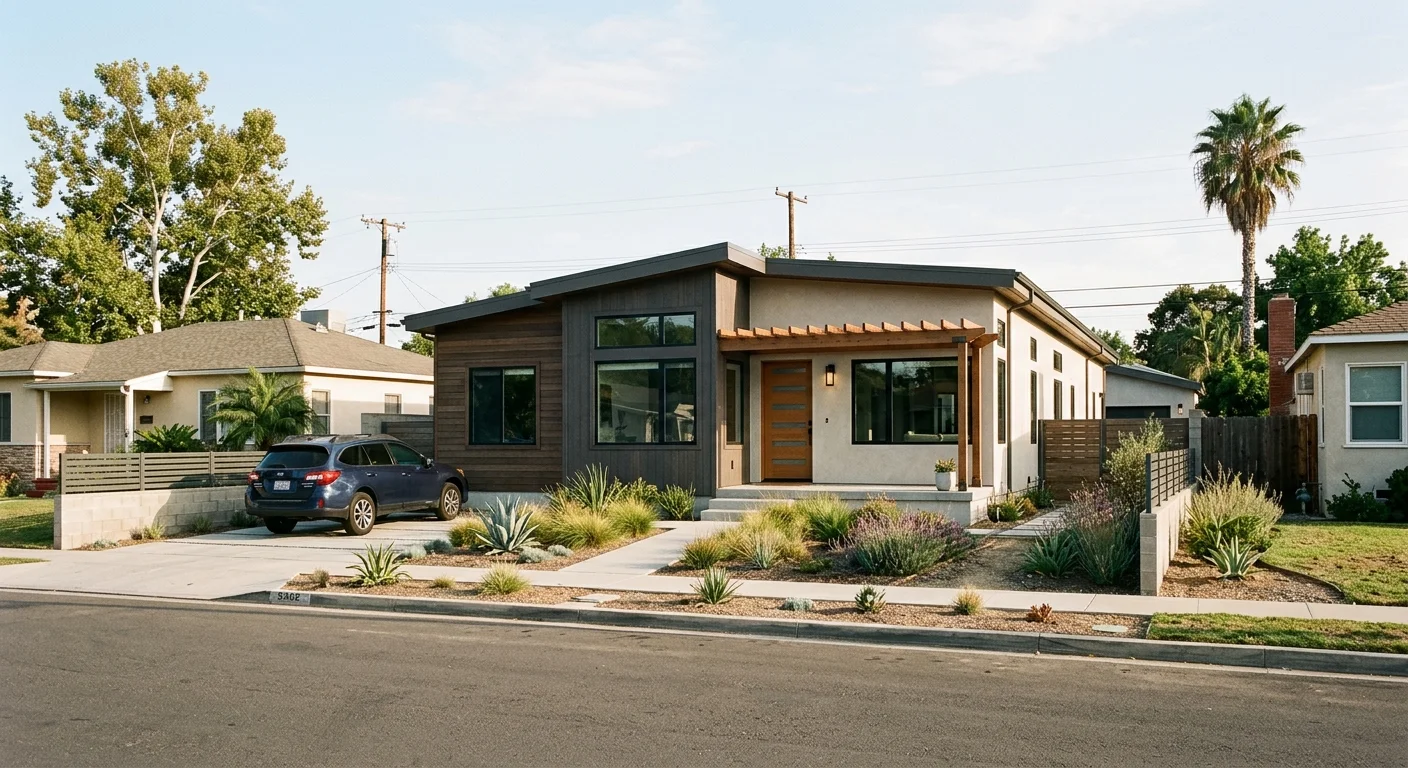
Define what factory-built means for this search
“Factory-built” sounds like one product category. In California, the words can point toward different legal and construction paths.
Under state law, factory-built housing includes residential units or building components made wholly or substantially offsite. The definition covers construction whose concealed work can’t be inspected without disassembly, damage, or destruction. Those pieces are then wholly or partly assembled onsite under California building standards. Modular homes generally follow this path.
A manufactured home is different. California defines it as a qualifying dwelling constructed on or after June 15, 1976, built on a permanent chassis, and designed for residential use when connected to required utilities. Federal construction and safety standards apply to manufactured homes from that date forward. California uses “mobilehome” for qualifying units built before that date.
“Prefab” is less precise in buyer conversations. It might describe a modular home, manufactured home, panel package, or another offsite building method. Don’t let that label carry the entire deal. Ask the seller to name the legal category in writing.
Our detailed manufactured, modular, mobile, and prefab comparison explains those terms further. California HCD also maintains its manufactured and mobilehomes information for buyers checking the state’s regulatory path.
For factory-built homes in suburbs, begin with four written answers:
- What legal category appears in the sales contract?
- Which construction standard applies to the home?
- Who handles the factory scope and the site scope?
- What title, registration, and permit path is proposed?
Those answers matter more than the marketing label.
Compare modular and manufactured paths
Modular and manufactured homes can both arrive with substantial factory work completed. That similarity doesn’t make their paperwork interchangeable.
A modular home falls within California’s factory-built housing framework. Its offsite construction and onsite assembly must comply with California building standards. The buyer should ask which documents identify the approved system, who manages onsite assembly, and which local approvals apply to the parcel.
A manufactured home built on or after June 15, 1976 follows federal manufactured home construction and safety standards. It remains built on a permanent chassis. California HCD handles manufactured home registration and titling rather than the Department of Motor Vehicles.
That distinction should appear throughout the transaction. Check the proposal, lender submission, permit description, foundation plan, escrow instructions, and insurance application. If one document calls the home modular while another calls it manufactured, stop and get the parties to correct or explain the mismatch.
For a new manufactured home, California law requires the original manufacturer’s certificate of origin to enter escrow. Used manufactured home transactions have separate title and registration documents. Buyers shouldn’t assume a modular closing uses those same records.
The practical tradeoff isn’t that one path wins every time. It’s whether one path fits the specific parcel, lender, contract, and ownership plan. Our Modular & Prefab Homes guide offers a starting point for the modular route.
Before choosing, ask each seller for a plain written summary covering:
- The home’s legal classification
- The construction standard named in the contract
- The seller and onsite contractor or installer
- The proposed title or registration treatment
- The approvals assigned to each party
- The documents a lender will receive
A buyer comparing complete paths can make a sounder decision than one comparing floor plans alone.
Match the home type to the lot
A suburban setting doesn’t settle whether a home fits. The exact parcel does.
San Diego County includes coastal North County, inland North County, central San Diego, East County, and South Bay. Those regional labels help organize a search, but they don’t answer a parcel-level permit question. Start with the property’s correct jurisdiction and the exact home classification.
Ask the planning authority to review a written project description. Include the proposed use, home category, dimensions, foundation concept, and parcel information. Don’t rely on a listing description that calls land “buildable.” Get the relevant agency’s current answer for the actual proposal.
Then test the physical delivery and assembly plan. A dealer, builder, installer, or transport professional should inspect the route and site. The written review should address road access, turns, gates, overhead obstacles, staging space, slopes, and any lifting plan. These items don’t automatically disqualify a parcel. They can change the home configuration, site scope, or contract.
Utility and ground questions also belong in the lot review. Ask the responsible professionals to identify utility connection points, drainage concerns, foundation information, and any studies the authority requires. Confirm which findings are conditions of the purchase contract.
The Putting a Home on Private Land guide explains the broader placement decision. Buyers still shopping for a parcel can also use our guide to buying land for a modular home in San Diego.
Keep the home choice provisional until these items align:
- The authority accepts the described residential use
- The proposed home fits the reviewed parcel plan
- Delivery and staging have a named solution
- Site professionals have defined their work
- The seller’s contract matches the reviewed format
That sequence turns “I like this model” into a parcel-specific buying decision.
Separate factory scope from site work
A factory proposal and a completed suburban home aren’t the same scope. Keep factory work and site work separate until the contracts connect them clearly.
The factory-side document should identify the model, specifications, options, included finishes, and construction standard. It should also explain changes, cancellations, delivery conditions, storage, and the written warranty documents supplied by the manufacturer. Land & Home SD doesn’t provide a warranty, and buyers should rely only on written terms from the responsible seller or manufacturer.
The site-side document may need to address surveying, design work, permit applications, grading, drainage, foundation work, utility connections, transport access, lifting, assembly, inspections, and finish work. Not every project needs every item. The contract should state which items apply, who performs them, and who pays each outside charge.
For a manufactured home placed as a permanent fixture, California law requires a building permit and specified supporting materials. Those materials include evidence of property ownership or an eligible lease, lien information, approved foundation plans, and the manufacturer’s installation instructions. Ask the enforcement agency for its current checklist and fee schedule before signing.
Use a responsibility sheet beside the contract. Give each task one named party and require a written scope. Mark anything excluded, conditional, or still awaiting agency review. This exposes gaps that a single total price can hide.
Check these handoff points closely:
- Who confirms the home dimensions used for site plans?
- Who verifies delivery access before the home ships?
- Who provides foundation and installation documents?
- Who submits requested corrections to the reviewing authority?
- Who coordinates inspections and final records?
- What happens if the approved site plan changes?
Don’t accept “handled by others” as a complete assignment. The contract should identify those others and connect their work to the project schedule and payment terms.
Verify permits, financing, and contracts
Finish due diligence with three files: an agency file, a lender file, and a contract file. Each should describe the same home on the same parcel.
For permits, confirm the reviewing jurisdiction first. San Diego County Planning & Development Services publishes the county’s planning and permitting information. If another local authority controls the parcel, identify that department and request its current written direction. Land & Home SD doesn’t issue permits or interpret an approval as guaranteed.
Give the agency an accurate home description. “Prefab house” may be too broad for a useful answer. State whether the proposal is modular factory-built housing or a manufactured home. Include the intended foundation and site plan when requested. Ask which applications, plans, reviews, and inspections apply. If a detail can’t be confirmed, record it as unresolved.
For financing, send the lender the exact home classification, parcel information, proposed foundation documents, contract structure, and title plan. Ask for a written list of required records and conditions. Don’t substitute a seller’s description for the lender’s review, and don’t assume a loan discussed for one format covers another.
The contract file should identify every legal party. Confirm the seller, manufacturer, dealer, builder, installer, and site contractors where applicable. Match each name to its scope, payment terms, change process, cancellation terms, delivery conditions, and warranty documents.
California HCD enforces licensing rules for manufactured home dealers and salespeople. Buyers can start with HCD’s occupational licensing page when checking the party involved. Ask the professional to provide the credential information needed for verification.
Before signing, compare all three files line by line. The home classification, parcel, foundation concept, responsible parties, and unfinished conditions should agree. Put unanswered issues into written contingencies or resolve them first. A verbal assurance isn’t a substitute for an agency response, lender condition, or signed contract term.
When to call us
A conversation is useful before you reserve a model, buy land, or accept a contract with unclear site exclusions. Land & Home SD can help organize the format, lot, and referral questions before you commit.
Call us at (858) 400-4608 and we’ll walk through your options and connect you with a licensed local dealer.