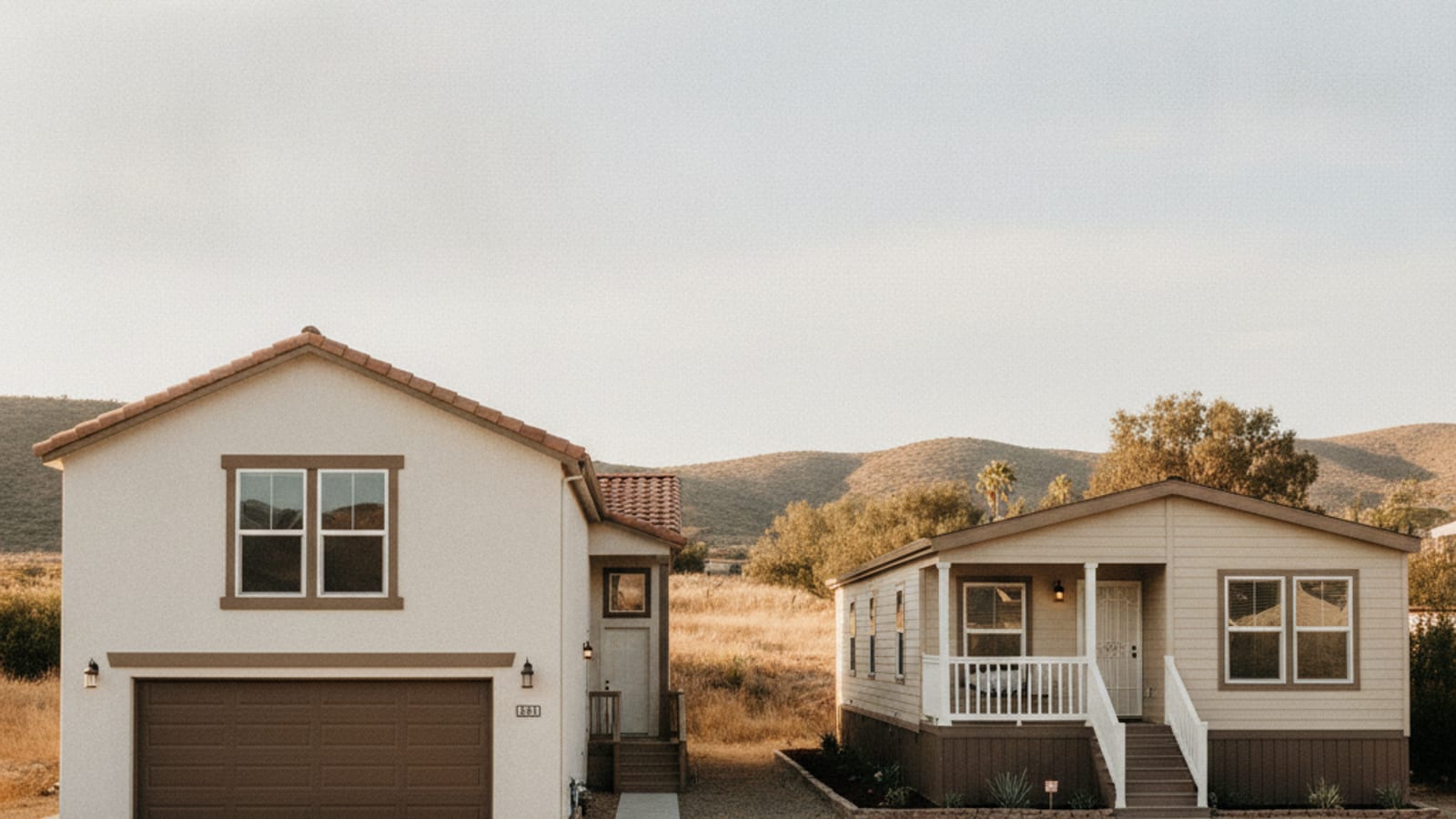
If you’ve been researching factory-built housing, you’ve probably seen these four terms used interchangeably. They’re not the same thing. Each refers to a distinct construction standard, regulatory category, and financing treatment. Using the wrong term with a lender, a county permit office, or a dealer creates confusion that costs time and sometimes money.
If you’re really just comparing modular vs manufactured home, here’s the short version: a manufactured home is built to the federal HUD code on a permanent steel chassis, while a modular home is built to California’s state building code with no chassis and is financed like a site-built house from day one. The full breakdown below covers both of those terms plus mobile and prefab, which get used loosely but mean something different in a legal or lending context.
Here’s a clear breakdown of what each term actually means.
Manufactured home
Definition: A home built entirely in a factory and transported to the site, constructed to the federal HUD Manufactured Home Construction and Safety Standards (MHCSS). It’s built on a permanent steel chassis that stays with the home.
Key features:
- Built to the HUD code, a federal standard administered by the Department of Housing and Urban Development
- Has a permanently attached steel chassis (the undercarriage)
- Has a red or silver HUD certification label on each section
- Can be placed in a land-lease park or on private land on a permanent foundation
- When placed on a permanent foundation on owned land and recorded through the HCD 433A process, it converts to real property and can be financed with a traditional mortgage
What “manufactured home” means legally: This is the precise legal term. California and federal law use it specifically for post-1976 HUD-code homes. When a lender, permit office, or assessor says “manufactured home,” this is exactly what they mean.
In San Diego County: Manufactured homes on permanent foundations are allowed in any zone that permits single-family residences. San Diego County’s Zoning Ordinance Section 6506 sets exterior standards (conventional siding, 2:12 roof pitch minimum, 1-foot eave overhang minimum) to bring them in line with the surrounding neighborhood.
Modular home
Definition: A home built in sections in a factory and assembled on-site, but built to state and local building codes, not the HUD code. Crucially, a modular home has no steel chassis. It’s designed to sit on a permanent foundation (stem wall or slab) from the start.
Key features:
- Built to California’s Title 24 and local building codes, the same standards as a site-built home
- No steel chassis
- Titled as real property from day one (no 433A conversion needed)
- Structurally indistinguishable from site-built construction after installation
- Often more architecturally customizable than manufactured homes
How it compares to manufactured: A modular home costs more to build because it must meet the same code as a stick-built house. It’s also financed and assessed exactly like a site-built home from the start. There’s no chattel loan risk, no conversion process.
In San Diego County: Modular homes are treated identically to site-built homes for permit and zoning purposes. The factory origin is invisible to the county once the home is installed.
Mobile home
Definition: A factory-built home constructed before June 15, 1976, when HUD standards took effect. The term is technically accurate only for pre-1976 homes.
Key features:
- Pre-HUD code construction
- Older, often in worse condition than post-1976 manufactured homes
- Cannot typically be newly installed on private land in California
- Still commonly found in land-lease parks that were established before modern regulations
Why the term persists: People use “mobile home” colloquially to refer to any manufactured home in a park, regardless of age. In everyday conversation that’s fine. In a legal, financing, or permit context, it means something specific: a pre-1976 unit.
Practical implication for buyers: If you’re buying an older home in a San Diego County park and the seller describes it as a mobile home or a “1972 model,” that means pre-HUD construction. Most lenders won’t finance pre-1976 homes, and insurance options are limited. Inspect carefully, understand the financing constraints, and factor both into your offer.
Prefab home
Definition: Prefab (short for prefabricated) is an umbrella term that covers any home built partially or entirely in a factory before being assembled on-site. It includes manufactured homes, modular homes, panelized construction, and even some kit homes.
What it is not: Prefab is not a legal term. No building code, lender underwriting guideline, or permit application uses “prefab.” It’s a marketing and colloquial term that can refer to any factory-built housing type.
Why it’s confusing: Upscale prefab companies often market modular homes as “prefab” to avoid the stigma historically associated with manufactured homes. That’s accurate in a general sense (it was prefabricated), but it obscures the fact that what they’re selling is a modular home with specific legal and financing characteristics. When a company says “prefab,” ask which HUD or state code it’s built to and whether it has a chassis. Those two questions tell you what you’re actually buying.
For San Diego buyers: If you’re shopping prefab in San Diego County, you need to know whether the specific product you’re considering is a HUD-code manufactured home or a state-code modular. That distinction determines your permit path, your financing options, and how the county’s assessor treats the property.
Side-by-side comparison
| Term | Code standard | Chassis | Foundation at install | Titled as | Financing |
|---|---|---|---|---|---|
| Manufactured | HUD federal standard | Yes (steel) | Park stand or permanent | Personal or real property | Chattel or mortgage |
| Modular | State/local building codes | No | Permanent from day one | Real property | Mortgage |
| Mobile | Pre-1976 no HUD code | Yes (steel) | Park stand | Personal property | Very limited |
| Prefab | Umbrella term | Depends | Depends | Depends | Depends |
What matters most for financing
Financing is where these distinctions hit hardest. The loan type available to you depends on whether the home is classified as personal property or real property.
Chattel loans (personal property): apply to manufactured homes not permanently affixed, including most park-placed homes. Higher interest rates (often 1.5 to 3 points above conventional mortgage rates), shorter terms (15 to 20 years), and higher monthly payments. FHA Title I is a government-backed chattel loan option.
Conventional mortgages (real property): apply to modular homes (always) and manufactured homes that have been permanently installed on owned land and converted via HCD 433A. Fannie Mae’s MH Advantage and FHA Title II programs specifically support manufactured homes on permanent foundations.
If you’re buying a manufactured home in a land-lease park, you’re almost certainly looking at a chattel loan. If you’re placing a manufactured home on land you own with a permanent foundation, converting to real property opens up better financing. That one decision affects your monthly payment and long-term cost significantly.
Still unsure which type fits your situation?
Land & Home SD works with buyers across all factory-built categories in San Diego County. Whether you’re looking at an existing park home, placing a new manufactured home on your land, or evaluating modular construction, we help you understand what’s actually available and what the financial and permit path looks like.
Call (858) 400-4608 or visit our modular and prefab homes service page to talk through your options. We’re not a dealer and we don’t get commissions on what you buy, so the guidance is genuinely impartial.