A backyard manufactured home in San Diego County turns on use, jurisdiction, and the lot. People in Clairemont, El Cajon, and Oceanside type the same search and mean different projects: a guest ADU, a rental, or housing for family. Name that use first, then confirm which city or County desk reviews your parcel.
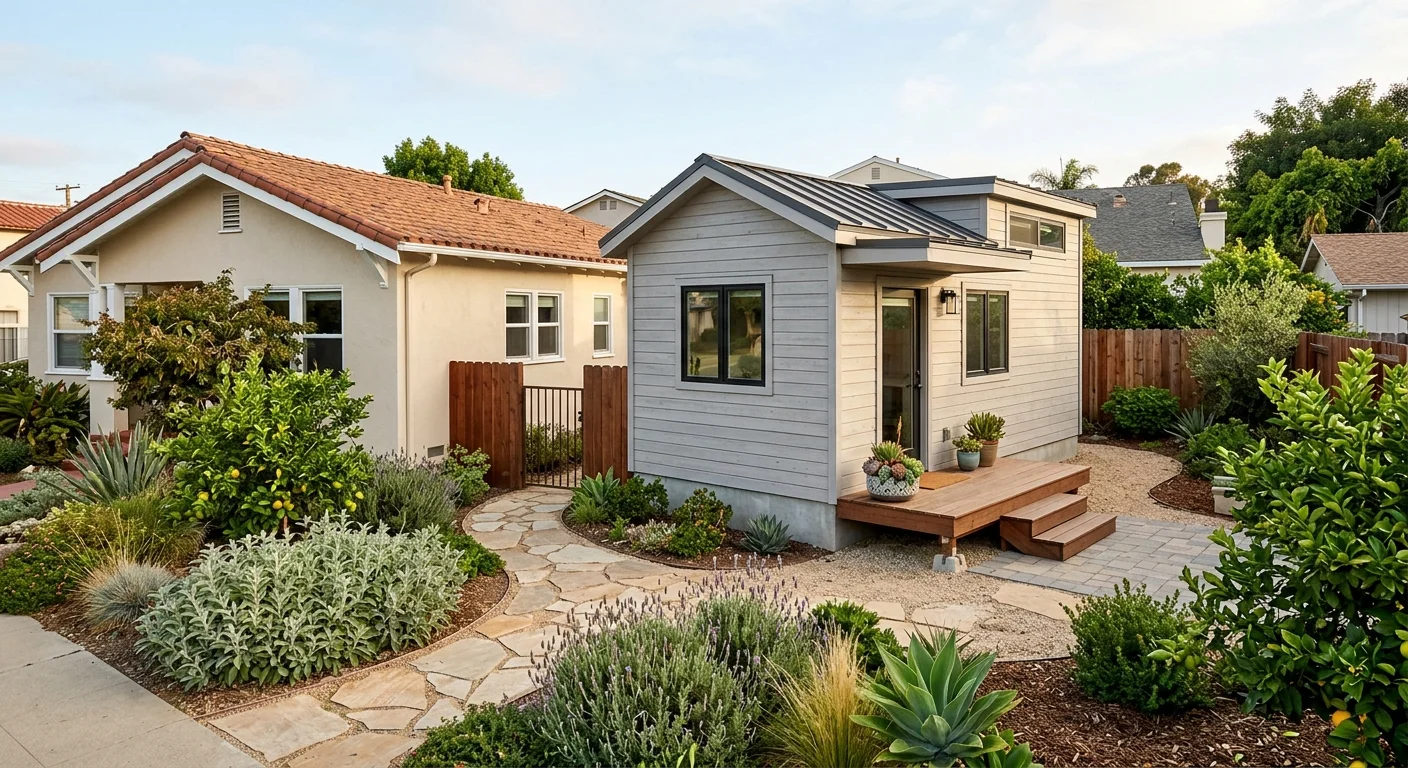
Start with how you plan to use the backyard home
The search is one sentence. The project is several. A compact HUD-code home behind a house that stays is one path. A modular cottage is another. A used mobilehome built before June 15, 1976 is a third. California treats those as separate products, and the planner will too.
Health and Safety Code 18007 defines a manufactured home. It is built on or after June 15, 1976, transportable in one or more sections, and set on a permanent chassis. It is designed as a single-family dwelling, with or without a permanent foundation, once it is connected to required utilities. Plumbing, heating, air-conditioning, and electrical systems are in the unit. In traveling mode it is 40 body feet or more in overall length, or when erected on site it is 320 or more square feet. It is also eight body feet or more in width, or 40 body feet or more in length.
A mobilehome under Health and Safety Code 18008 is that same chassis-built dwelling constructed before June 15, 1976. Factory-built housing under Health and Safety Code 19971 is the modular path: substantially built offsite, then assembled on site to California Building Standards Code. That statute excludes mobilehomes, recreational vehicles, and commercial modulars. A trailer tiny home is a different product again. Say the legal category out loud when you call planning.
HUD construction and safety standards apply to manufactured homes built on or after June 15, 1976. Federal law treats those construction rules as broadly preemptive. States keep authority over stabilizing systems, support systems, and foundations, consistent with the manufacturer’s design. Modular homes follow state and local building codes. Pre-1976 mobilehomes sit outside the HUD Code.
Then write the occupancy in one line. Overnight guests a few weeks a year. Full-time housing for a parent. A long-term rental. A studio an adult child will live in. A manufactured home backyard ADU in San Diego is a second dwelling on a lot that already has a main house. A rear unit meant to become the only house is a primary-dwelling project.
If the backyard idea is really the main home on land you already own, start with putting a home on private land. If the front house stays and the rear unit is extra living space, stay on the ADU track below. A unit on a parent’s lot still needs the owner’s written approval. It still needs the same city or County review as any other second dwelling. Family occupancy does not skip permits, utilities, or foundation work.
Identify the city or county jurisdiction
San Diego County is not one permit shop. An Oceanside side yard, a City of San Diego canyon lot, a Chula Vista interior lot, and an unincorporated Lakeside parcel go to different counters. Incorporated cities run their own planning and building desks. Unincorporated communities go through San Diego County Planning & Development Services.
Read a tax bill or a recent permit. The agency named there is the one that will accept or reject a backyard unit. A neighbor’s approval in El Cajon does not bind Santee. County handouts do not bind Encinitas city limits. Bring the assessor parcel number, not a city nickname.
For unincorporated private lots, County PDS publishes eligibility notes for manufactured homes on private land (PDS 103, revision 09/18/2025). That handout covers qualifying mobilehomes built September 15, 1971 through June 14, 1976, and manufactured homes built from June 15, 1976, with the stated approval or certification. It also states roof-pitch and eave rules, with exceptions and Director-waiver language. Those County notes stop at County jurisdiction. A Carlsbad, National City, or Escondido lot still has to be checked with that city.
Coastal north county lots are often tight, with alleys, coastal height review, and older side yards. Inland north county and East County lots can be larger, with slope, wildland fire access, and septic questions. South Bay lots can be small and already built out. The central city mixes canyons, alleys, and overlay areas. Name the neighborhood when you call. “San Diego County” is too broad for a counter tech.
HOA covenants and recorded restrictions sit on top of public rules. A planned community in Poway or San Marcos can block a factory-built backyard unit after the city would hear the file. Pull the CC&Rs and any design guidelines before you spend on a floor plan.
California’s manufactured-housing regulator is the Department of Housing and Community Development. HCD licenses dealers and salespeople, handles registration and titling for homes that remain in that system, and publishes statewide manufactured-home material. Local planning still decides whether your backyard use is on the table.
Separate an ADU path from a primary dwelling
Most backyard searches are ADU searches. An accessory dwelling is a second home on a lot that already has a main house. A primary dwelling is the main house itself. Those are different files, different findings, and often different dealers.
California publishes accessory dwelling unit policy through HCD’s ADU page. Cities and the County still apply local review. We could not confirm a single setback, height, parking, or size figure that applies to every San Diego County backyard. Ask the jurisdiction that issues your certificate of occupancy. A factory flyer and a neighbor’s permit are not your rule.
If the backyard unit is meant as a manufactured home ADU, say that at the counter. Ask whether a HUD-code manufactured home is an accepted construction type for an ADU on your parcel. Ask whether a modular factory-built unit is accepted as well. Ask whether the unit must sit on a permanent foundation. Get the answer in writing. Our manufactured ADU overview for San Diego stays on that second-unit track.
Health and Safety Code 18551 covers installation as a permanent fixture. Before that installation, the owner obtains a building permit and provides proof of ownership or a long-term lease of 35 years or more (or mutually agreed terms), evidence the home is lien-free or written consent from lienholders, department-approved foundation plans and specifications, the manufacturer’s installation instructions, and a statutory fee of $11 per transportable section. That fee is the figure in the statute. Confirm the current amount with the enforcement agency before you pay. Within five business days of a certificate of occupancy, the enforcement agency records a document naming the owner of the real property and stating the home has been affixed.
A home installed on a foundation system is no longer registered by HCD. Follow HCD’s registration and titling guidance to cancel registration and confirm the property record. That step does not, by itself, prove a lender will treat the backyard unit as real estate.
Keep the two projects separate in every email to a dealer. A granny-flat quote is a poor fit for a primary-home install, and the reverse is also true. Occupancy and rentals are local. Short-term rental rules are a separate question from ADU approval. Ask the city or County about nightly rentals on their own line, in writing.
Check access, utilities, and lot constraints
A lot can look open from the kitchen window and still fail delivery. Factory sections arrive on trucks. They need a path from the street, room to set, and a way to leave. Side yards in Mission Hills, North Park, or Imperial Beach can be tight even when the rear lawn looks generous. Overhead lines, mature trees, retaining walls, and a neighbor’s eave all eat clearance. Fire-access questions show up more in East County and on canyon edges.
This article stays on use and approval path. For tape, turning room, and pad thinking, use the manufactured ADU lot-fit checks. Here, list the constraints the planner and the installer both need: street width, gate width, slope, drainage, easements, and any recorded utility strip. Photograph the side-yard path in daylight.
Utilities stop more backyard jobs than zoning talk does. A second dwelling needs water, sewer or septic, power, and often gas. Panel upgrades, long trenches, and septic capacity are common blockers on older lots. Rural unincorporated land may be on well and septic. A second bedroom count can force a system review. City lots on public sewer still need the serving agency to confirm the tap. Capacity is a letter from the utility, not a guess from last month’s bill.
Ask the serving utilities, in writing, whether existing services can support a second dwelling. Then ask planning whether those letters belong in the application. Keep them with the parcel map.
Soils, slope, and flood or fire overlay are parcel facts. A level Clairemont pad is a different site from a Ramona hillside. A licensed installer and, when the jurisdiction requires it, a design professional confirm those conditions. Land & Home SD does not inspect lots and does not approve parcels.
HUD Title I can finance a manufactured home, a lot, or both. HUD states the home may be classified as personal property or as real estate. In some HUD Title I cases, borrowers may lease a lot, with a required initial lease term of three years and at least 180 days’ advance written notice if that lease will be terminated. A typical backyard ADU sits on land you already own, so that lease language may never come up. Treat the HUD summary as program background. It is not an approval, a rate, or a term for your unit.
Get written findings before you request quotes
Dealers quote homes. They do not replace the planning desk. Send floor plans out after the jurisdiction says a manufactured backyard unit is a recognized path on your lot. Drawings ordered before that finding often get thrown out.
Ask planning and building for written notes on whether a second dwelling is allowed on the parcel, whether a HUD-code manufactured home is an accepted type for that use, whether a modular factory-built unit is accepted, whether a permanent foundation is required, which department inspects the install, and what site reports they will require. Bring the APN, a simple site sketch, and photos of the side-yard path. Ask which overlay maps apply: coastal, historic, fire, flood, canyon. Write down the planner’s name and the date.
Take those notes to a licensed independent dealer and installer. Verify occupational licensing through HCD’s licensing pages. The dealer sells the home. The installer sets it. You contract with them directly. Land & Home SD is a referral service. We match you with licensed local manufactured-home professionals. We do not sell inventory, pull permits, or perform the work.
Quotes should separate the home, delivery, foundation, utility work, and permit processing. If a number bundles everything, ask for a split. Market prices move, and site work swings with trench length and slope. We do not publish a backyard-home price here because no primary source on this site sets one. Itemized quotes after written findings are the honest comparison, including against a site-built ADU.
If the written finding is no, stop the order. A redesign as modular, a garage conversion, or a different lot may be the next honest step. If the finding is yes, with conditions, those conditions belong in the dealer packet before anyone orders a section.
Keep every owner aligned. A backyard unit changes how the lot is used and how it may sell. County assessment practice for a new unit could not be confirmed from a public assessor source we could rely on. Ask the County tax collector or assessor how a permitted second dwelling is treated after occupancy, and get that in writing too.
When to call us
Call before you reserve a floor plan, and after you know which city or County desk owns the parcel. A backyard ADU and a primary home on the same land are different files, and that split is worth a conversation before anyone orders a section. Call us at (858) 400-4608 and we’ll walk through your options and connect you with a licensed local dealer.