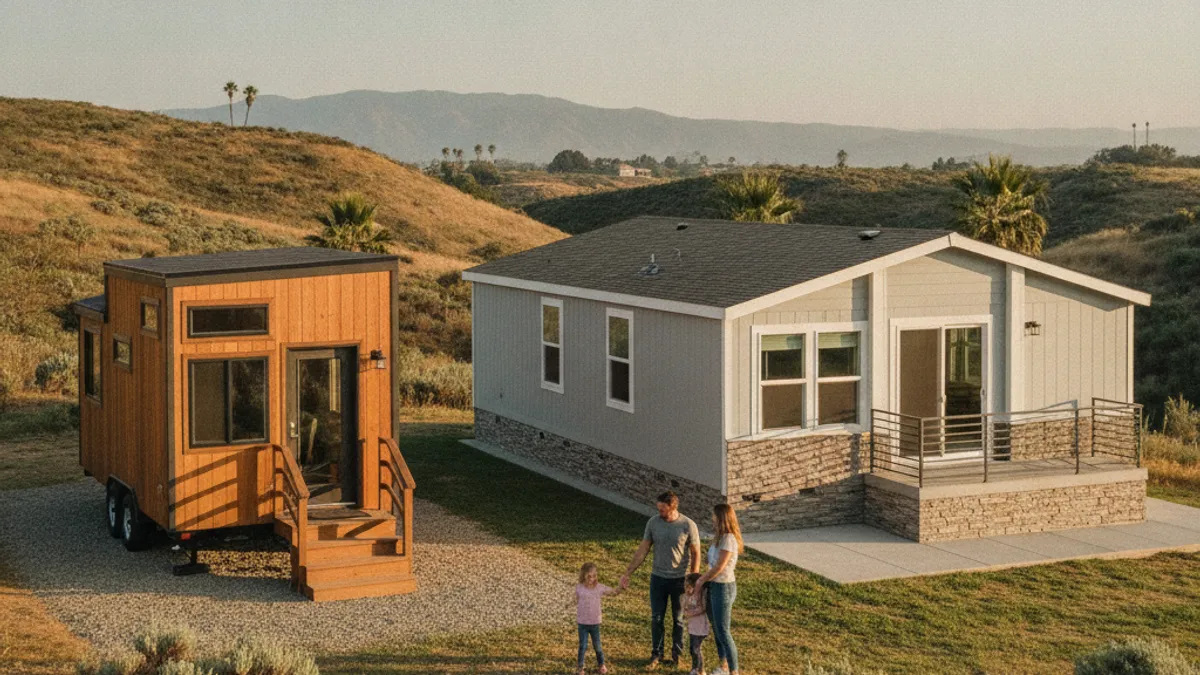
Tiny houses and manufactured homes both get pitched as the affordable alternative to a traditional stick-built home, and both can be considerably cheaper than a conventional San Diego County house. They’re not really competing for the same buyer, though, once you look past the sticker price on the structure itself.
What each one actually costs to build or buy
A manufactured home built to federal HUD standards typically runs a wide range depending on size, layout, and finish level, and that price generally includes a far more complete, code-inspected structure than most tiny houses on wheels. Tiny houses vary enormously in cost because there’s no single standard: a DIY build on a used trailer costs far less than a builder-finished tiny house from a specialty manufacturer, and the gap between those two is much wider than the gap between manufactured home models.
The number on the home itself is rarely the full financial picture for either option in San Diego County. Land, whether you’re buying a lot, leasing space in a park, or parking on someone else’s property, tends to be the larger and more variable cost.
Where you can actually put each one
This is where the two options diverge the most. Manufactured homes have an established path in San Diego County: manufactured home communities built specifically for them, and placement on private land where local zoning allows it. That path exists because manufactured housing has decades of established regulatory framework behind it.
Tiny houses on wheels occupy a much less settled position. Some are classified and permitted as recreational vehicles rather than dwellings, which restricts where and how long they can be lived in full-time. Others fall under accessory dwelling unit rules if they’re placed on a foundation and meet the requirements for that classification. Which category applies, and what’s actually allowed on a specific parcel, depends on your local jurisdiction’s current zoning and building code, and it can vary meaningfully between the city of San Diego, the county’s unincorporated areas, and other cities within the county. This is a question for your local planning department, not a general assumption either way.
Financing looks different too
Manufactured homes have well-established financing paths, including loans specifically structured for manufactured housing, whether the home is titled as real property on owned land or as personal property in a leased-lot community. Tiny houses on wheels are harder to finance conventionally, since many lenders treat them more like a vehicle or a specialty RV loan than a home mortgage, and terms vary significantly by lender. If financing is a major part of your decision, talk to a lender who specifically handles the type of home and land situation you’re considering, since general assumptions about loan terms don’t hold consistently across either category.
Long-term costs beyond the purchase
A manufactured home in a community typically carries an ongoing space rent payment in addition to whatever the home itself cost, plus community amenities and rules that come with it. A tiny house on owned land avoids space rent but takes on the full cost of land ownership, permitting, utility hookups, and septic or sewer connection if it’s not on an already-developed lot. Both paths have costs that don’t show up in the initial purchase price, and both are worth mapping out fully before you commit to either direction.
Which one actually fits your situation
If you want a permanent, code-built home with an established community and financing path, and you’re comfortable with either a lease-lot arrangement or buying land outright, a manufactured home is generally the more straightforward option in San Diego County. If your priority is mobility, a much smaller footprint, or you already have compliant land lined up for it, a tiny house might fit better, but you’ll want to nail down the zoning and financing details before you build or buy rather than after.
Frequently asked questions
Is a tiny house cheaper than a manufactured home overall?
It depends heavily on the build quality of the tiny house and where you’re placing either option. Once land, permits, and financing are factored in, the total cost picture can look very different from a simple sticker price comparison.
Can I legally live in a tiny house full-time in San Diego County?
That depends on how the specific structure is classified and where you’re placing it, since zoning and building code treatment vary by jurisdiction and by whether the tiny house is on a foundation or wheels. Check with your local planning department before assuming either way.
Is it easier to get a loan for a manufactured home or a tiny house?
Manufactured homes generally have more established financing paths than tiny houses on wheels, but terms and availability vary by lender in both cases. A lender who specializes in the type of home you’re considering can give you accurate current terms.
Do manufactured homes hold value better than tiny houses?
Value depends heavily on location, home condition, and whether the home sits on owned land or leased space. It’s not a simple comparison, and a local specialist can walk through what typically happens with each in San Diego County.
If you’re weighing a manufactured home against other housing options in San Diego County, call Land & Home SD at (858) 400-4608 and we’ll walk through what actually fits your budget and your land situation.