Buying a manufactured home in San Marcos starts with one decision: park space or private land. The address may look right, but the ownership, title, installation, and permit paths can be very different.
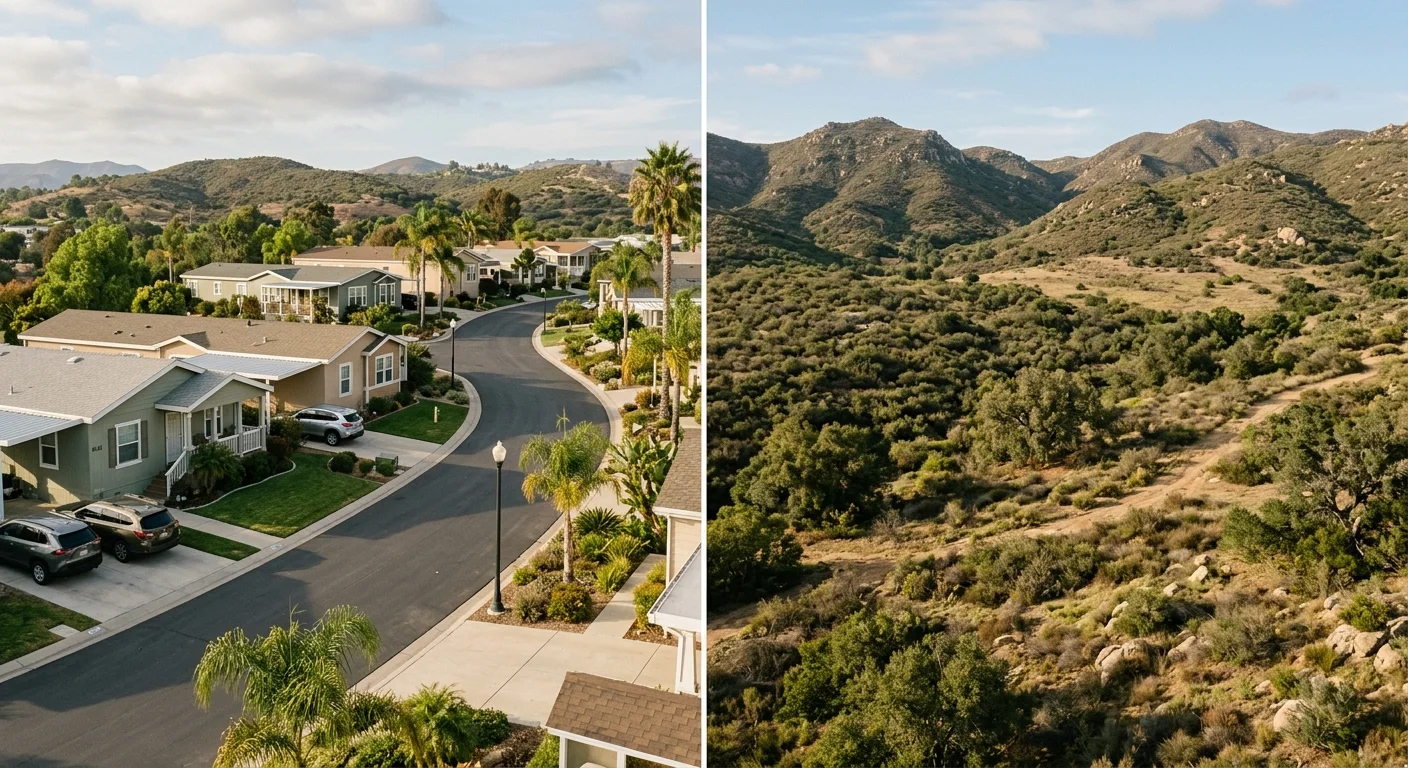
Separate San Marcos from Lake San Marcos results
Don’t treat San Marcos and Lake San Marcos as interchangeable search labels. A result associated with Lake San Marcos doesn’t answer the property questions for another San Marcos address. Treat every listing as its own file.
Start with the exact address, parcel, and community name. Confirm whether the offer includes a home, a park space arrangement, private land, or some combination. A city name in a headline isn’t enough to establish the property path.
Listing terminology also needs attention. Under California law, a manufactured home is constructed on or after June 15, 1976. A mobilehome is constructed before that date. Both categories have specific legal definitions involving size, transportability, a permanent chassis, and residential use.
Modular homes are another category. California treats them as factory-built housing. They’re regulated differently from manufactured homes and mobilehomes. Don’t let a loose use of “prefab,” “mobile,” or “modular” change your review.
Before comparing two San Marcos manufactured homes, record four answers:
- What exact property or park space is involved?
- How does the seller describe the home’s legal category?
- Is land included in the proposed transaction?
- Which agency holds the title, permit, or parcel records?
If an answer remains unclear, pause the comparison. Ask the seller, dealer, park contact, and permitting authority for written confirmation. Clear records matter more than a familiar place name.
Compare a park space with private land
Build separate files for the park and private-land options. Don’t compare only the homes. Compare the agreements, property rights, approvals, installation plan, and costs attached to each path.
For a park candidate, request the current space agreement and park documents. Ask what the buyer must approve, sign, or provide before moving forward. Confirm every current charge directly with the park.
California’s Mobilehome Residency Law applies to mobilehome park residency. It doesn’t apply to manufactured homes on private land. Buyers should review the current documents and get qualified advice when a term is unclear. Our guide to mobile home parks in San Diego County provides a broader comparison framework.
For private land, confirm who owns the parcel and what installation is proposed. If the home will become a permanent fixture under California Health and Safety Code Section 18551, the owner must obtain a building permit. The process also calls for property or qualifying lease evidence, lien information, approved foundation plans, and the manufacturer’s installation instructions.
Those state requirements don’t confirm that a particular San Marcos parcel will work. The parcel still needs its own review. Our private-land placement service helps buyers organize that conversation with an independent local professional.
Check access, utilities, and permit responsibility
Access isn’t settled by seeing an open parcel on a listing page. Those details must be checked for the exact home and site.
Ask the installer to review the proposed travel and placement path. Request written notes covering the home’s transport sections, road access, turns, grades, overhead clearance, staging area, and final pad approach. Measurements should come from the project professionals, not an online photo.
Build a similar record for utilities. Identify the provider for each service at the property. Then ask where each connection sits, what work is proposed, who performs it, and whether the work appears in the written scope. Don’t assume a nearby line means the planned connection is approved or included.
Permit responsibility also belongs in writing. Use the parcel’s jurisdiction to identify the correct enforcement agency. If county jurisdiction applies, San Diego County Planning & Development Services is the county reference point. If city jurisdiction applies, ask the city to identify the current permitting authority and required review.
For a permanent-foundation installation, state law requires a building permit before the home becomes a permanent fixture. The dealer or installer should explain which licensed professional handles each physical task. Land & Home SD doesn’t install homes, connect utilities, prepare foundations, or pull permits. We connect buyers with licensed independent local professionals.
A useful responsibility sheet names one party beside every task. If nobody accepts a task in writing, it remains unresolved.
Separate the home quote from site work
A home price doesn’t establish the full project cost. Request current written amounts for the home, site work, park or parcel obligations, delivery, installation, permits, utilities, financing, insurance, and other transaction items that apply.
Ask for a home quote that clearly identifies the proposed unit. It should describe the model, included features, seller, and quote period. Buyers comparing available options can start with manufactured and mobile homes for sale, then confirm every detail with the licensed dealer.
Use a separate scope for placement and site work. Ask the responsible professional to mark each possible item as included, excluded, not applicable, or pending review. The review may need to address:
- Transportation and delivery access
- Site preparation and grading
- Foundation or support system
- Installation and assembly
- Utility connection work
- Permit and inspection responsibility
- Steps involving title or registration
- Cleanup and unfinished work
This list doesn’t establish which items a San Marcos project requires. It prevents an undefined item from disappearing between quotes.
Keep allowances and verbal statements out of the comparison unless they’re explained in writing. Record who supplied each amount, what it covers, and when it can change. Land & Home SD doesn’t set dealer, installer, park, or government charges.
Private-land buyers should also read the San Diego private-land manufactured home guide. Use it to frame questions, then get current answers for the actual parcel.
Verify the property path before committing funds
The last review should connect the seller, home, title, site, permit authority, and installer. If those pieces describe different transactions, the file isn’t ready.
California HCD, not the DMV, handles manufactured-home registration and titling. For a used-home resale, state law requires specified registration and title documents in escrow. Documents held by junior lienholders also enter that process. An escrow officer may request tax clearance for a home subject to local property taxation.
For a new manufactured home, the original manufacturer’s certificate of origin must be placed in escrow. These rules don’t confirm the status of a particular San Marcos home. Review the current record through HCD registration and titling, and ask HCD or the escrow professional which current documents apply.
Dealer and salesperson licensing also falls under HCD enforcement. Start with HCD occupational licensing, then follow HCD’s current instructions to confirm a professional’s status before signing.
Be careful with foundation shorthand. Ask HCD and the correct enforcement agency to identify the current document and recording path.
Your final file should answer five points: what you’re buying, where it sits, who controls the land or space, who handles each licensed task, and which authority confirms the path. Don’t commit funds while one of those answers depends on an assumption.
When to call us
A conversation is useful when you’re comparing a park home with a private San Marcos parcel, or when the title and placement paths don’t match. Land & Home SD can help organize the questions before you commit. Call us at (858) 400-4608 and we’ll walk through your options and connect you with a licensed local dealer.