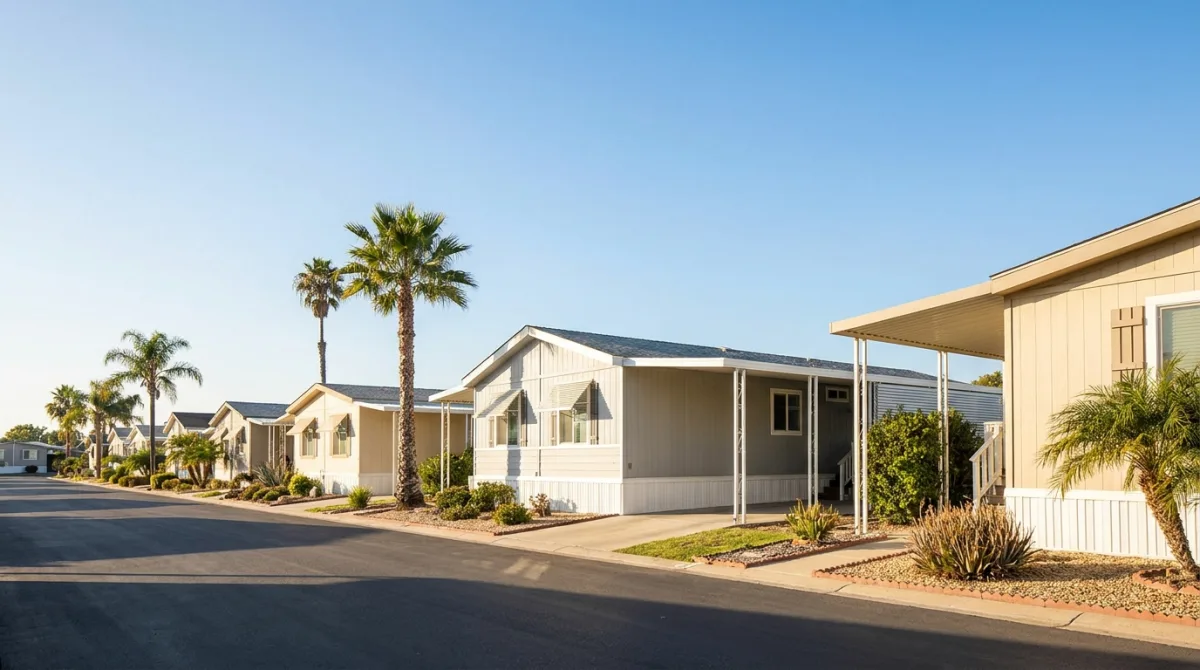
A resident-owned mobile home park is a community where the homeowners collectively own the land through a cooperative or association, instead of leasing space from an outside park owner. You still own your home outright, same as anywhere else, but instead of paying open-market space rent to a landlord who can raise it however the market allows, you pay a monthly co-op assessment or HOA fee that the residents’ own board sets and controls.
This guide walks through what this ownership model actually is, how it differs from a standard land-lease park or buying private land outright, how financing works when you’re buying into one, and which real San Diego County communities run this way.
What is a resident-owned mobile home park?
In this ownership model, the residents hold a collective interest in the land itself, usually through a nonprofit cooperative corporation or a homeowners association that owns the parcel. When you buy a home in one of these communities, you’re buying two things at once: the home, and a membership share in the entity that owns the ground under it. That share is what replaces the lease agreement you’d sign in a standard park.
California law nudges some parks toward this structure directly. The Mobilehome Residency Law, in Civil Code Chapter 2.5 beginning at Section 798, sets out notice rules that can apply when a park owner intends to sell, and a registered resident homeowners’ association is the body those rules run through. Ask a California mobilehome attorney which notice rules apply to a specific park, because the details decide whether residents get a real window to organise. That window is what lets organised residents pursue buying the park collectively instead of watching it sell to another investor. Not every resident-owned park in the county got there this way, some were built or converted decades ago, but the mechanism explains why California has a real, ongoing supply of these conversions instead of it being a rare accident.
How is a resident-owned park different from a land-lease park or owning private land?
A standard land-lease park is the arrangement most buyers already picture: you own the home, an outside owner (often a corporate operator) owns the land, and you pay monthly space rent that can climb every year, subject only to the state’s 90-day notice rule and whatever local rent ordinance, if any, applies in that city. Owning private land is the opposite end: you own the home and the ground under it outright, with a much higher upfront cost and full responsibility for the parcel.
This ownership model sits in between those two. You don’t carry the full cost of a private lot, since the land purchase is spread across every homeowner in the community, but you’re not exposed to an outside landlord’s rent decisions either. Your monthly cost is a fee your own board sets to cover the community’s actual expenses, taxes, insurance, road maintenance, and reserves, not whatever the open market will bear. The tradeoff is governance: you’re now one voting member of an association, and decisions about assessments, rules, and capital projects get made collectively, not handed down from a park office.
How do you finance a home in one of these communities?
This is where the model gets more complicated than either a land-lease park or a private lot. Because you’re buying a home plus a membership share, not fee-simple land, most conventional and FHA mortgage programs don’t apply cleanly. A small number of specialized lenders write share loans built for resident-owned and co-op communities, and those loans can land closer to conventional mortgage terms, lower rate, longer amortization, than a standard chattel loan. Not every lender offers this product, so ask directly whether a lender has closed a share loan in a resident-owned park before you get attached to a specific home.
Our manufactured home financing guide breaks down chattel loans, FHA options, and the real-property mortgage path in full, and it’s worth reading before you shop lenders for a co-op purchase specifically.
What do you pay each month in a resident-owned community?
Instead of space rent, residents in these parks pay a monthly HOA fee or co-op assessment. At Rancho Carlsbad, a large resident-owned 55+ community in Carlsbad with roughly 504 homes, that fee isn’t published online, and some homes carry little or no separate land charge on top of it. Get the current figure from the community office. Smaller resident-owned parks, like the 25-space Hacienda Family Park in Fallbrook, typically charge a comparable monthly assessment scaled to a much smaller shared budget.
The number moves for the same reasons any HOA fee moves: the size of the community, its amenities, deferred maintenance, and how well-funded its reserve account is. A gated 282-space community with a pool, spa, and clubhouse is going to run a different budget than a 25-space park with no shared amenities. Ask for the association’s current budget and reserve study before you buy, the same way you’d ask a condo HOA for its financials, since that document tells you far more than the listed monthly fee alone. Our manufactured home cost guide covers how these recurring costs stack up against buying on private land.
Which San Diego County parks are resident-owned?
San Marcos has the county’s densest cluster of resident-owned mobile home parks, with communities including Casitas Del Amigos, Casitas Del Sol, Foothills of San Marcos, La Moree Mobile Home Estates, Madrid Manor, San Marcos View Estates, and Twin Oaks Valley Park. El Cajon runs a similar cluster, with Pecan Park Mobile Home Estates, Royal View Gardens, The Meadows, and Vista Royal all operating as resident-owned cooperatives rather than standard land-lease parks.
Beyond those two clusters, Rancho Carlsbad in Carlsbad is one of the county’s largest resident-owned 55+ communities, with an 18-hole golf course and roughly 504 homes on guard-gated grounds. Mission Valley Village, a 119-space 55+ co-op off Mission Gorge Road in central San Diego, and Lake Jennings Park Estates in Lakeside, a gated 282-space 55+ cooperative in the Cuyamaca foothills, both run the same ownership model. Hacienda Family Park in Fallbrook is a smaller, all-ages example, with about 25 spaces jointly owned by its residents.
That said, not every park in these same cities uses this structure. Standard land-lease parks sit right alongside resident-owned ones in San Marcos, El Cajon, and San Diego proper, so never assume ownership type from the city name or even from a nearby park’s listing. Confirm it directly with each community before you make an offer.
Is a resident-owned park the right fit for you?
A resident-owned mobile home park tends to fit buyers who want more rent predictability than a land-lease park offers, without taking on the full upfront cost and maintenance responsibility of a private lot. It’s a particularly common fit in 55+ communities, where residents are often looking for a stable, self-governed budget more than a growth investment. It’s a weaker fit if you specifically want full-property appreciation and eventual real-property mortgage eligibility, since a co-op share is not the same asset as fee-simple land, even with a share loan in place.
Before you make an offer, ask the association for its bylaws, its current reserve study, and at least three years of assessment history. Ask whether the community has ever had a special assessment for a major repair, and if so, what it was for and how it was funded. Our guide to San Diego County mobile home parks covers the same due-diligence questions for land-lease parks, and most of them apply here too, alongside the co-op-specific questions above.
Frequently asked questions
What does resident-owned mean for a mobile home park?
Buying a home in the park also means buying a membership share in that entity.
Do you still pay space rent in a resident-owned mobile home park?
No, not in the traditional sense. Instead of open-market space rent, residents pay a monthly HOA fee or co-op assessment that the association’s own board sets to cover shared expenses like taxes, insurance, and maintenance.
Can you get a mortgage on a home in a resident-owned mobile home park?
Sometimes. A small number of lenders offer share loans built specifically for resident-owned and co-op communities, and those can come closer to conventional mortgage terms than a standard chattel loan. Not every lender offers this, so confirm directly before assuming financing will work the same way it would in a land-lease park.
Which San Diego County cities have the most resident-owned mobile home parks?
San Marcos and El Cajon have the county’s densest clusters, each with several resident-owned communities. Carlsbad, Fallbrook, Lakeside, and central San Diego also each have at least one well-established example.
Is a resident-owned park better than owning private land?
Not automatically. Owning private land gives you full appreciation potential and no association to answer to, at a much higher upfront cost. A resident-owned park spreads the land cost across every homeowner and caps your monthly cost through a self-governed budget, but you’re a voting member of an association rather than a sole owner.
How do you find out if a specific park is resident-owned?
Ask the park or its listing agent directly, and ask for the association’s governing documents if it is. Ownership structure varies park by park even within the same city, so never assume it from the community’s name, its age restriction, or a nearby park’s listing.
Land & Home SD isn’t a park or a lender. We help San Diego County buyers understand how a specific community’s ownership structure actually affects the numbers, the financing, and the fit. Call (858) 400-4608 for a free, no-pressure conversation, or start with our San Diego County manufactured homes hub and our mortgage and financing guide to see how the loan side compares.