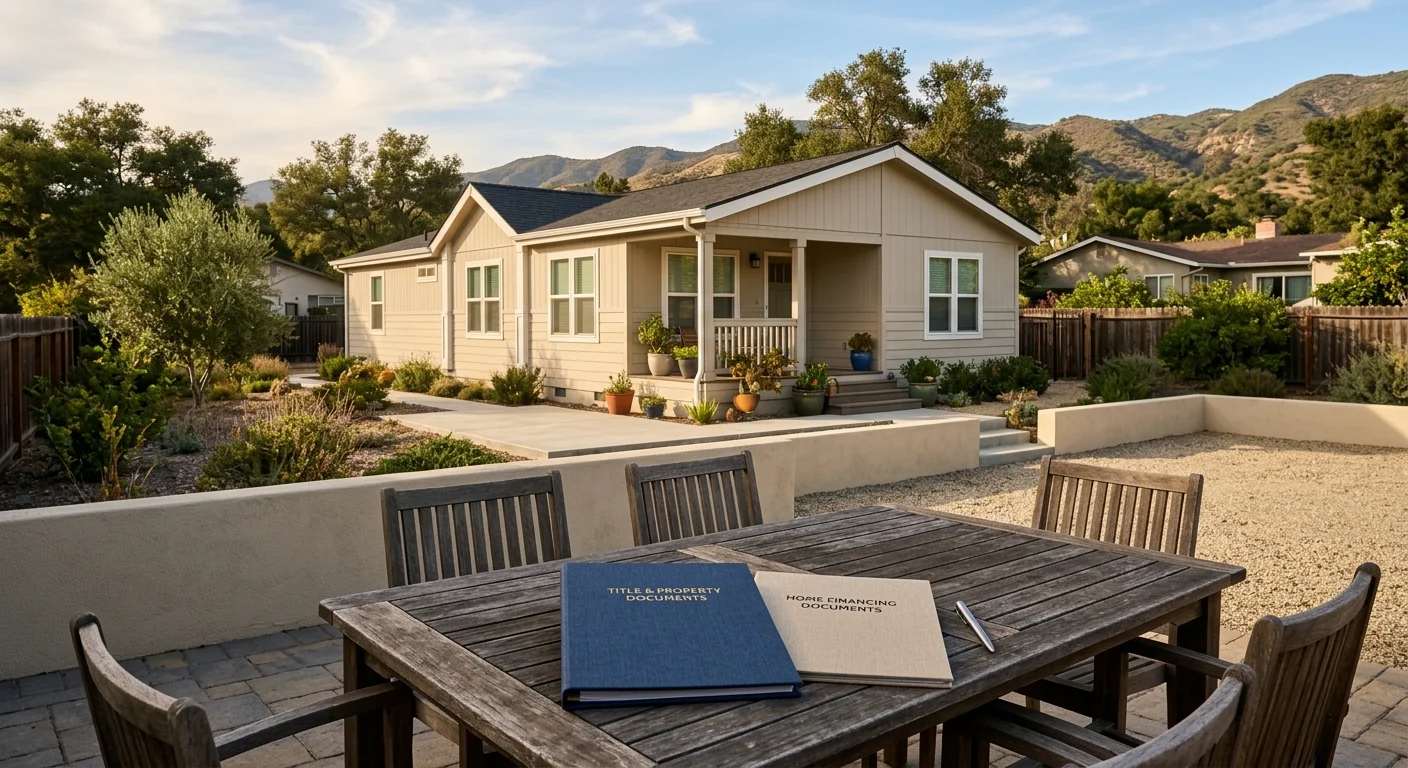
Buyers who want one loan for the house and the dirt usually walk in with two stacks of paper. One stack is the home’s California title file. The other is the parcel. In San Diego County those two records have to line up before a lender will treat them as a single manufactured home and land loan.
Start with the home’s title and land status
A combined loan is a property file, not a slogan. Lenders ask what the home is under California law, who holds the land, and whether the home is still on its own title. People say “mobile home” in conversation. The year still matters.
Under California Health and Safety Code 18007, a manufactured home is a structure built on or after June 15, 1976, on a permanent chassis, designed as a single-family dwelling. Health and Safety Code 18008 uses the same size and chassis tests for a mobilehome built before that date. Post-1976 homes must meet the federal HUD Code. Pre-1976 mobilehomes do not. A lender who sees “1974” and “1984” is looking at two different products.
Registration and titling run through the California Department of Housing and Community Development, not the DMV. HCD’s consumer guidance says a manufactured or multifamily manufactured home installed on a foundation system is no longer registered by HCD. That is a record change. It is not a lender approval, and it does not prove a particular San Diego parcel is ready to close.
Land status is the other half. A home in a Chula Vista or National City park, where you own the unit and rent the space, is a different file from a home on a private lot in Lakeside, Ramona, Valley Center, or Alpine. Coastal north county lots in Oceanside, Carlsbad, and Encinitas often add HOA, setback, and access limits that East County dirt does not. South Bay inventory skews toward park communities. Inland north county still has more private-land placements. A page that treated Encinitas and El Cajon as the same land story would miss the county.
If the plan is to affix the home as a permanent fixture, Health and Safety Code 18551 requires a building permit first. The owner has to show property ownership or a long-term lease (35 years or more, or mutually agreed terms), evidence the home is lien-free or written consent from lienholders, approved foundation plans, and the manufacturer’s installation instructions. Within five business days of a certificate of occupancy, the enforcement agency records a document naming the owner of the real property and stating the home has been affixed. Local agencies cannot require a permanent foundation for homes already on private property or in parks, with limited exceptions for park conversions.
That recording can change how the home is classified for later financing, tax, and resale. Title professionals, the dealer, and the public office that holds the record confirm what is actually on file. Land & Home SD does not issue titles. For the land side of a private-lot plan, start with putting a home on private land before you shop loan labels.
Separate land loans from home-only loans
Yes, you can finance a mobile home and land together. HUD Title I can finance a manufactured home unit, a lot, or both. HUD states the home may be classified as personal property or as real estate. That is the federal program we can point to from a primary source. It is not a promise that your file, your credit, or your San Diego parcel will be approved, and it does not set a rate or a term.
HUD Title I also allows the borrower to lease the lot, including a site in a manufactured home community or mobile home park. For that path, HUD requires an initial lease term of three years and at least 180 days’ advance written notice if the lease will be terminated. That is a leased-lot rule inside Title I. It is not the same as buying the dirt.
Keep the three files separate in your head.
A home-only loan covers the unit. The land stays with the park, a landlord, or a seller you are not buying from. Monthly space rent, if any, sits beside the loan payment. It is a different collateral stack from a land-and-home file.
A land-only loan, or a cash land purchase, covers the parcel. The home is still a second problem: delivery, foundation, utilities, and a later loan or cash for the unit. Buyers who grab a Fallbrook or Ramona lot first, then hunt for a home, often discover the land loan and the home loan will not snap together later.
A combined manufactured home and land loan tries to put both in one closing. That only works when the lender’s current program accepts that pairing, and when the title path supports it. Buying land and a manufactured home at the same time is the same test. The calendar of two closings does not create one loan. The file does.
Other loan names you will hear in ads (conventional, VA, USDA, and similar) are set by each lender and investor. Those approval rules, down payments, and limits are not confirmed in our claims ledger, so we will not invent them here. Ask the lender what program they are actually offering on this home and this parcel. For how those choices sit next to a mortgage on a manufactured home in San Diego, keep the land question in the same conversation. Our manufactured home financing page is the buyer-side map. For listings sold as a pair, read manufactured home and land packages in San Diego before you treat a Zillow bundle as one loan.
Match lender questions to the property file
A useful lender conversation is a document dump, not a credit-score fishing trip. We will not quote a minimum score, a down payment, or a payment on a $100,000 home. Those figures are not in our verified ledger, and each lender sets them. What you can match, today, is the property.
Bring the build year and the HUD label or data plate on a post-1976 home. Bring the HCD registration and title path, or the recorded foundation evidence if registration was cancelled after a foundation install. HCD publishes the consumer pages for registration and titling and for manufactured and mobilehomes. Use those pages as the place the regulator talks. Do not treat a blog as a substitute for the record.
Bring the land: grant deed, legal description, and whether you already own the parcel, are buying it in the same escrow, or are leasing a park space. If it is a lease, the lender will want the actual lease, not a park brochure.
Bring jurisdiction. Unincorporated county lots go through San Diego County Planning & Development Services. County PDS 103 (revision 09/18/2025) covers eligible manufactured homes on private lots in County jurisdiction. Eligibility includes qualifying mobilehomes built September 15, 1971 through June 14, 1976, and manufactured homes built from June 15, 1976, with the stated approval and certification. Roof-pitch and eave rules in that handout have exceptions and Director-waiver language. Those are County rules. They are not a snow-load rating, and they are not automatic inside El Cajon, Santee, La Mesa, Escondido, Oceanside, or Chula Vista. Incorporated cities run their own building departments. Confirm the lot with the office that actually issues the permit. County’s door is sandiegocounty.gov/pds.
Bring access and utilities as facts, not hopes. East County wells and septic, South Bay sewer taps, and coastal flood or bluff notes change underwriting even when the floor plan is the same. Delivery width on a two-lane Ramona road is part of the same file as the loan.
Then match the lender’s questions to those papers. If they ask whether the home is personal property or real estate, answer from the recorded status, not from what you hope to convert. If they ask about a foundation, point to the permit and the recorded affidavit under HSC 18551 when that path was used. If they ask about a park, say you do not own the land. Do not force a combined-loan story onto a space-rent home.
Compare conditions using the same facts
Shop one file across lenders. Do not shop five different stories.
Write down the home (year, sections, HUD or pre-HUD), the land (owned, buying, or leased), the jurisdiction (County or named city), and the title path (HCD registration still open, or foundation recorded and registration cancelled). Send that same packet every time. When a loan officer changes the story (“we can do the home now and the land later,” or “this only works if you own the lot already”), you can see the change.
Compare conditions that are actually on the letter: what collateral they will take, whether the land must close in the same escrow, whether a leased lot is even in the program, and what they still need from HCD or the city. Do not compare a park chattel quote to a private-land quote and call one “cheaper.” They are not the same purchase.
Cost questions come up fast. How expensive is it to buy land and put a manufactured home on it in San Diego County. There is no single verified market figure we can publish. Coastal north county dirt, East County acreage, and a South Bay park space are not one price band. Dealer quotes, land listings, permit invoices, and utility estimates have to come from those parties, in writing, on that address. Monthly payments on a round number like $100,000 are the same trap. The payment depends on the program, the term, taxes, insurance, and any space rent. Ask the lender for a written estimate on your file. Treat anything else as a guess.
Used versus new changes the paper, not just the carpet. A used home still needs a clean title path through HCD escrow rules for the current registration card, junior lienholder copies, and certificate of title. Tax clearance can enter the file when a used home is subject to local property tax. None of that is a rate. All of it can stop a combined closing.
If two lenders will not take the same pairing, the problem is often the land or the title, not your patience. Fix the file with the dealer, the title company, and the public office. Then go back.
Confirm every current term before offering
Offers fail when the buyer assumes yesterday’s program still exists. Confirm the live term with the lender who would make the loan, in writing, on this home and this parcel. Confirm ownership and liens with a title professional. Confirm the dealer or salesperson against HCD occupational licensing. Confirm permits with County PDS or the city building department that has the lot.
Land & Home SD does not make loans, approve borrowers, sell homes, or issue titles. We are a referral service. We match San Diego County buyers with licensed, independent manufactured home professionals. The customer contracts and pays that professional directly. The brand holds no dealer license, no inventory, and no lender book.
Do not offer on a combined file until the lender has said, for this address, whether the home and the land can sit in one loan. Do not offer on a park home as if you were buying the dirt. Do not offer on a private lot in unincorporated county using a city’s old rule of thumb. Do not treat a foundation plan as recorded until the enforcement agency has recorded it.
If the land and the home cannot be financed together on current terms, that is still an answer. You can buy one piece, pause, or walk. A clean no is cheaper than a double closing that never merges.
When to call us
Call before you write an offer that treats the home and the land as one loan, and before you sign a land contract that leaves the home unfinanced. If the parcel is in unincorporated county, in a South Bay park, or on a private East County lot, that split is worth a conversation first. Call us at (858) 400-4608 and we’ll walk through your options and connect you with a licensed local dealer.